Anti-Slip Landing Cover Plates: What Works
Anti slip landing cover plates reduce slip risk on industrial stairs and platforms. Learn materials, fixings, tolerances and where each spec fits.
Landing incidents rarely start with a dramatic failure. They start with a half-step onto a wet chequer plate, a boot sole picking up drilling mud, or a painted edge that has polished smooth under traffic. The landing is also where people turn, carry loads, and change pace so any loss of friction is more likely to become a fall.
Anti slip landing cover plates are a straightforward control for that risk, but the details matter. A cover plate that looks aggressive on day one can become a maintenance issue if it traps contaminants, causes rocking under point loads, or introduces a lip that becomes a trip hazard. The goal is consistent, predictable footing under real operating conditions, not just a product that photographs well.
What anti slip landing cover plates actually do
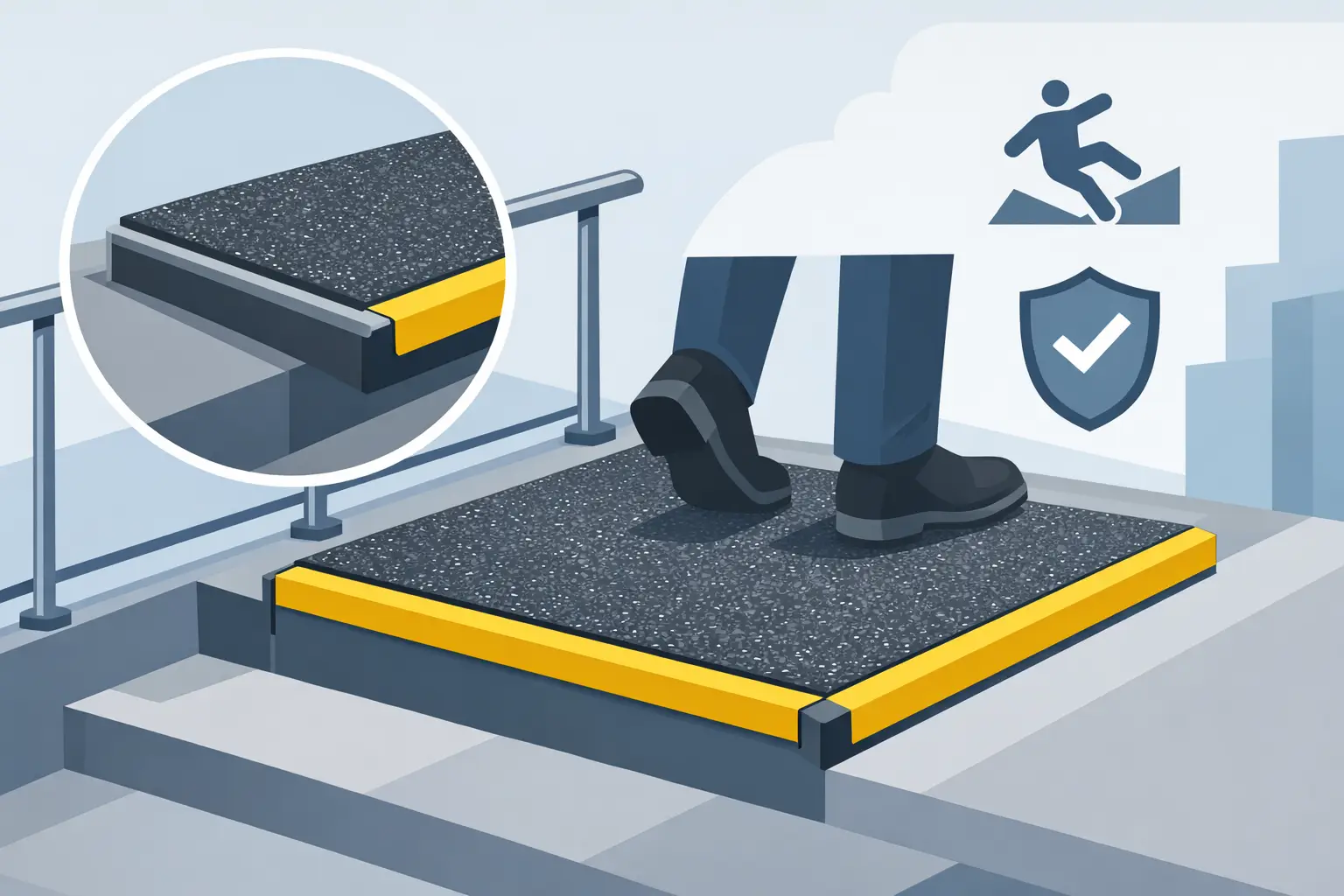
A landing cover plate is a retrofit surface installed over an existing landing typically steel chequer plate, open grating, concrete, or timber to increase slip resistance and improve edge definition. In industrial environments, it also acts as a barrier layer between aggressive contaminants and the substrate.
On sites with offshore exposure, chemical washdowns, or mixed pedestrian and light equipment traffic, the landing often sees the worst combination: moisture plus fine particulates that behave like ball bearings. A correctly specified anti-slip cover plate increases the coefficient of friction through a bonded grit surface (or moulded texture), while maintaining stability under load and keeping transitions flush.
The practical benefit is not just fewer slips. A stable landing surface reduces hesitations and compensatory movements that lead to strains, dropped items, and secondary incidents particularly on access routes where people are wearing PPE, carrying tools, or moving in low light.
Where landings fail in the real world
Most landing surfaces do not become unsafe overnight. They degrade.
Paint systems wear through on the turning line. Chequer plate loses definition as the high points polish. Gratings clog with salt, dust, or ice and then become unpredictable either too slick on top or hazardous where debris changes the walking pattern. Landings at door thresholds and platform transitions are also prone to differential movement, which creates small lips that catch toes.
It is common to see well-maintained stair treads paired with a landing that has been “left for later”. That gap matters because a person’s centre of mass shifts when they step onto the landing and prepare for the next flight or turn. If that landing has lower friction than the steps, you have effectively designed a skid point into the access route.
Choosing the right surface: grit, profile and cleanability
Slip resistance is the headline requirement, but the route to reliable performance depends on what is actually on your boots.
Coarse aggregate finishes can perform extremely well in wet conditions and with heavy contamination, but they can also be harder to clean if the landing is subject to frequent washdown or if hygiene requirements apply. Finer textures can be easier to maintain but may not provide the same confidence under oily residues.
In practice, you are balancing three variables: expected contaminants (water, oil, drilling mud, algae, ice), cleaning regime (washdown frequency and method), and traffic type (pedestrian only, trolleys, occasional wheeled access). A landing cover plate that is perfect for a coastal access stair may be the wrong choice for a plant room where maintenance teams regularly drag toolboxes.
If wheeled traffic is part of the use case, surface aggression must be considered carefully. Extremely sharp aggregates can increase rolling resistance and accelerate wear on wheels, which may push operatives to avoid the intended route. In those cases, specifying a surface designed for mixed pedestrian and wheeled movement - or segmenting the landing into pedestrian and equipment paths can be the more sustainable control.
Material selection: why GRP composites are frequently specified
For many industrial landings, non-metallic options are chosen not just for grip but for lifecycle performance. GRP composites bring a set of advantages that map directly to high-risk environments.
They are corrosion resistant in coastal and chemical atmospheres, which is critical where a steel landing can develop pitting, rust scale, and unevenness that undermines both slip resistance and footing stability. GRP is also lightweight, which reduces manual handling risk during installation and can be important on renewables assets where weight is a design constraint.
A further benefit is electrical non-conductivity, which can support safety-by-design in certain operational contexts. That said, “non-conductive” does not remove the need for proper electrical safety management it is a material property, not a control for poor isolation practices.
Metal anti-slip plates have their place. Stainless solutions can be appropriate for high-temperature environments or where mechanical abuse is extreme. The trade-off is that corrosion control and long-term surface predictability need closer attention, particularly where dissimilar metal contact and salt exposure exist.
Fixing methods: the difference between secure and serviceable
A landing cover plate must not move. Even small deflection or rocking under load will reduce confidence and can create noise, accelerated wear, and trip risk.
For steel substrates, mechanical fixings are common. The critical points are hole placement, edge distances, and ensuring fasteners do not create proud heads in the walking line. For grating, clamps or specialised fixings may be required to avoid compromising load rating.
Adhesive bonding can be effective on sound concrete or prepared steel, particularly where penetrations are undesirable. The reality is that bonding is only as good as surface preparation and environmental control during cure. If the area cannot be taken out of service long enough to prep, prime, and cure correctly, a purely bonded solution may become a maintenance problem.
Many sites adopt a hybrid approach mechanical restraint with supplementary bonding to control lift at edges while maintaining serviceability. Whatever the method, plan for inspection and replacement. A landing cover plate is a wear surface; treating it as permanent without maintenance access is how small issues become shutdown work.
Tolerances, edges and transitions: where trip hazards get introduced
The most common retrofit mistake is solving slip resistance while introducing a toe-catcher.
Edges should be managed so that the transition is flush or ramped, particularly at doorways and at the top and bottom of flights. If the plate sits proud because of debris under the panel or because the substrate is uneven, the fix is not “tighten it down harder”. The correct approach is to level the substrate, specify appropriate thickness, and use edge finishing that suits the access pattern.
Pay attention to drainage paths. Landings that pond water will always be higher risk, no matter how aggressive the surface. If the cover plate design blocks existing drainage or creates a dam at the edge, you can worsen the hazard you intended to control.
Visual definition also matters. High-contrast edging can improve foot placement in low light or high glare environments, but it must be durable. Painted stripes on a landing can disappear quickly under traffic. A system where the visual cue is integral or protected will outperform surface coatings that rely on frequent refresh.
Compliance and evidence: what HSE and engineering teams look for
Industrial buyers rarely need convincing that slips are a problem. They need a control that stands up to scrutiny after an incident and that can be justified against internal standards.
That means documented slip resistance performance, clarity on operating limits (wet, oily, contaminated), fire and smoke properties where relevant, and load and deflection characteristics suitable for the substrate. It also means installation guidance that does not assume ideal conditions.
A good specification considers the whole access route rather than treating the landing in isolation. If the stair treads, nosings, and landing surfaces have inconsistent friction or inconsistent visual cues, users will still misstep. Integrating landing cover plates with stair step covers, nosings, walkway covers and escape route markings provides a consistent “language” underfoot, which is exactly what you want in high-consequence environments.
Typical applications where cover plates earn their keep
Landings are not all equal. The value of anti slip landing cover plates is highest where exposure and behaviour combine.
Offshore and maritime assets see salt spray, wet boots, and frequent turning movements at platforms. Renewables access systems often face algae growth, wind-driven rain, and strict weight expectations, making lightweight composite solutions attractive. Heavy industrial plants contend with oils, coolants, dust and routine washdown, which drives the need for surfaces that maintain grip without becoming impossible to clean.
Construction and infrastructure sites add another variable: rapid programme changes. If you need a retrofit control that can be installed quickly to reduce incident risk without extended downtime, cover plates can be a pragmatic option - provided the fixings and edge control are designed for the substrate you actually have, not the one shown on a drawing.
Specifying well: the questions that prevent rework
Before raising a purchase order, clarify the basics: substrate condition, contamination type, wheeled traffic, and any fire, chemical, or electrical requirements. Also consider installation downtime and who will manage future inspections.
When those basics are defined, supplier selection becomes more objective: you can compare datasheets, installation methods, and service life expectations on like-for-like terms.
For organisations managing multiple assets, working with a specialist supplier such as Real Safety at https://Realsap.com can also help standardise upgrades across stairs, landings, walkways, and ladders.
The most useful way to think about a landing cover plate is not as a “grip product”, but as a designed interface between people, PPE and the site conditions you cannot eliminate. If you specify it with the same discipline you apply to any other risk control - surface, fixings, edges and maintenance - it will quietly do its job for years, which is exactly what you want from safety hardware.
Similar Articles

GRP Grating for Offshore Platforms: What Works
GRP grating for offshore platforms reduces corrosion and slip risk while cutting maintenance. Learn selection, load ratings and install considerations.

Offshore Stair Retrofit Case Study
Offshore stair retrofit reduced slip incidents case study showing how GRP stair covers improved grip, cut risk exposure and supported compliance.

Anti-slip ladder rung covers that hold up
Choose ladder rung cover doesn´t have to be confusing. Discover how to choose the right profile, fit, and material for long-term performance.