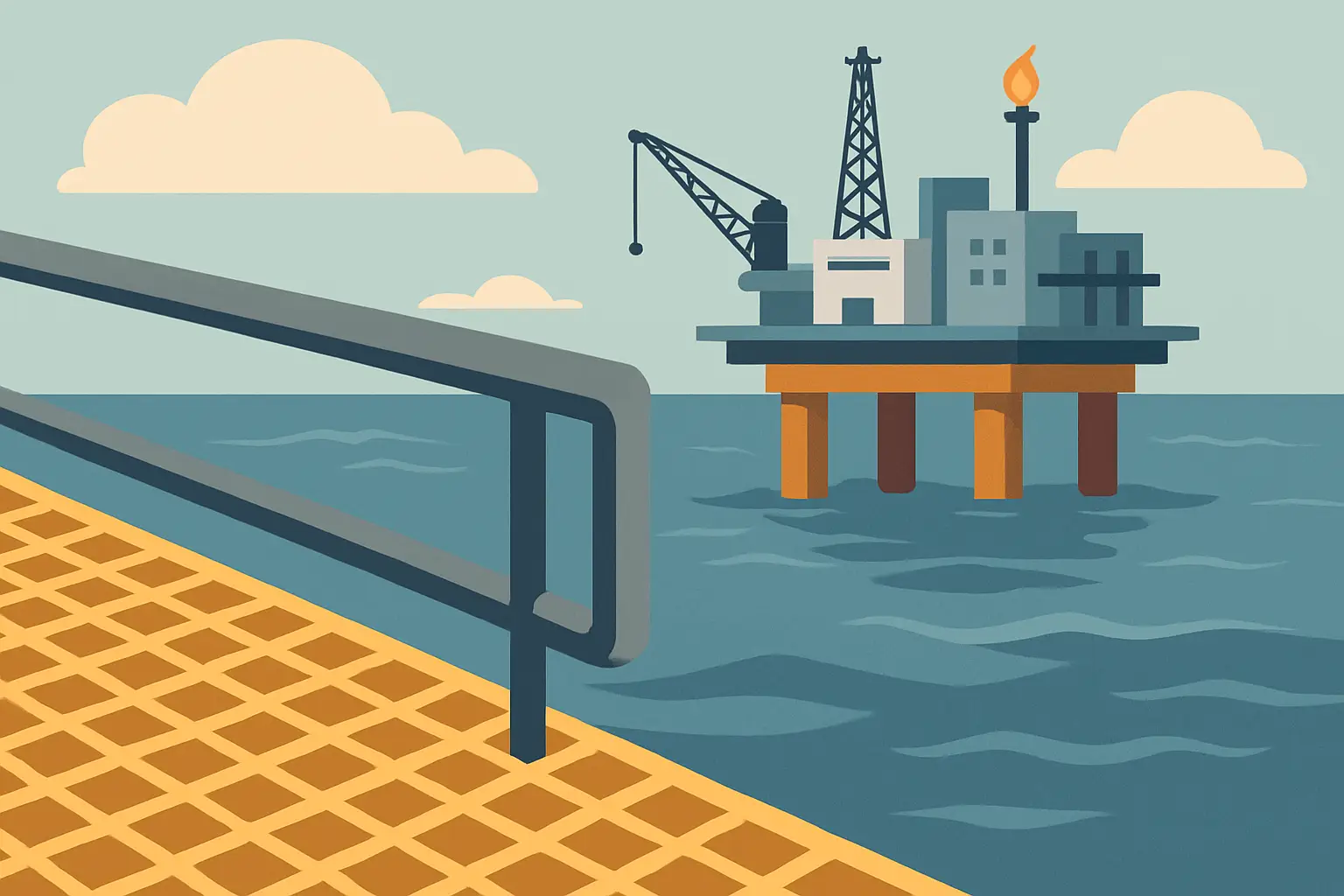
GRP Grating for Offshore Platforms: What Works
GRP grating for offshore platforms reduces corrosion and slip risk while cutting maintenance. Learn selection, load ratings and install considerations.
Salt spray, drilling fluids and constant washdowns do not just degrade steelwork they steadily erode confidence in the walking surface. When grating starts to pit, edges lift, fixings seize or coatings polish smooth, the issue stops being “maintenance” and becomes a live fall-risk control problem. Offshore, where access windows are tight and downtime is expensive, grating needs to stay predictable under foot, remain structurally sound, and avoid becoming the next corrosion-driven replacement cycle.
That is where GRP (glass-reinforced plastic) grating earns its place. Used correctly, GRP grating for offshore platforms provides a non-metallic, corrosion-resistant deck surface with stable anti-slip performance and low lifecycle burden. Used poorly wrong resin, wrong panel depth, poor support centres, unsuitable cut-edge sealing - it can create avoidable compliance and reliability gaps. The difference is specification discipline.
Why GRP grating is specified offshore
Offshore platforms concentrate the three conditions that punish conventional metallic systems: chloride exposure, mechanical abrasion, and aggressive cleaning regimes. Even when steel grating is galvanised or painted, the coating system becomes a consumable layer. Once it is breached - by dropped tools, dragged kit, or simply time corrosion starts at edges and bearing bars, and the programme becomes reactive.
GRP changes the failure mode. As a composite, it does not rust. That does not mean it is immune to damage, but it does mean you remove a major degradation mechanism that drives unplanned replacement and creates secondary hazards (sharp edges, section loss, loose panels). For many operators the most compelling argument is not weight or even cost it is the ability to keep a walking surface within its intended safety performance without constant intervention.
Slip risk is the other driver. Offshore walkways, drill floors, helideck approaches and stair landings see a mix of water, mud, hydraulic fluids and occasionally hydrocarbons. GRP grating can be supplied with integral grit or moulded anti-slip surfaces that maintain traction when wet, reducing reliance on temporary tapes or frequent recoating.
GRP grating for offshore platforms: the performance questions that matter
Procurement teams often start with panel size and price per square metre. Engineering and HSE teams should start with performance, then let the geometry and cost follow. The right questions are practical.
First is chemical and UV compatibility. Not all GRP is the same - resin selection influences resistance to chemicals, fire performance and long-term stability in exposed environments. Offshore assets may require specific resin systems depending on splash zone exposure, cleaning agents, and proximity to process areas.
Second is load and deflection behaviour. GRP does not behave like steel under load. It is strong, but it is more elastic, so support centres and panel depth need to be correct to control deflection and vibration. Excessive flex does not just feel unsafe; it can loosen fixings over time, affect hand-carry tasks, and encourage informal workarounds such as stepping around “springy” bays.
Third is surface specification. “Anti-slip” is not a single performance level. A coarse surface may be right for exposed walkways but too aggressive for areas where kneeling, crawling or frequent cleaning occurs. Conversely, a smoother finish can become a fall risk when contaminated. The correct approach is to match surface type to the contamination profile and the task - not simply to standardise one finish everywhere.
Finally, consider maintainability and inspection. Offshore systems are judged over years. The best grating is the one that stays serviceable with minimal intervention and is straightforward to inspect for damage, cut-edge integrity and fixing condition.
Where GRP grating typically delivers the most value
Offshore platforms contain a mix of high-traffic routes and task-specific work areas. GRP grating tends to justify itself quickly in locations where corrosion and wet contamination combine with frequent footfall.
Walkways and perimeter routes are a common starting point because they set the baseline for daily movement. When operators know the primary routes are stable and consistent, it reduces both incident risk and the time lost to cautious movement in poor conditions.
Stair landings and access platforms are also high consequence. A slip at a level change is more likely to escalate into injury. GRP grating used with compatible non-slip stair treads and nosings can help standardise traction from deck to stair and back again, particularly around accommodation access points and process module connections.
In and around drilling activity, the environment becomes more abrasive and impact-prone. GRP can still be appropriate, but specification needs to account for dropped tools, dragged equipment and localised point loading. In these areas, panel thickness, support steelwork, and protection strategies matter as much as the grating itself.
Specification basics: resin, panel type and support centres
Two manufacturing forms dominate: moulded (often with a square or rectangular mesh) and pultruded (with bearing bars and tie bars). Moulded grating typically offers strong bi-directional load capacity and good corrosion resistance; pultruded grating generally provides higher load capacity in the primary span direction and can suit longer spans when oriented correctly. The selection is rarely “one is better” it depends on span direction, point loads, and how much cut work is required.
Support centres should be engineered, not assumed. Offshore retrofits often inherit existing steelwork with non-standard centres. If the new grating is simply “made to fit”, you can end up with excess deflection or poor fixing engagement. A proper survey that captures actual support spacing, level differences, and obstruction locations usually saves time later by reducing site modification.
Cut edges require attention. When GRP panels are cut to fit around pipework, stanchions or penetrations, the exposed fibres need appropriate sealing to maintain durability and avoid wicking or surface degradation over time. This is a small line item in the work pack, but it has an outsized impact on long-term performance.
Fire, smoke and toxicity: do not leave it to assumptions
Offshore environments are regulated for good reason. If a deck system is part of an escape route, muster access, or near ignition sources, the fire performance of the material becomes a selection criterion rather than a nice-to-have.
GRP formulations can be selected to meet specific fire performance requirements, but this must be confirmed through relevant test data and datasheets. The critical point is that “GRP” alone is not a fire rating. HSE and engineering teams should align the grating specification with the platform’s fire and escape strategy, including any requirements for low smoke or reduced toxicity in certain zones.
Installation and retrofit: reducing offshore disruption
The strongest commercial case for GRP offshore is often the installation window. Lightweight panels reduce manual handling burden and can simplify lifting plans compared to heavy steel sections, especially for smaller maintenance crews operating under time pressure.
That said, offshore retrofits succeed or fail on detail. Fixing systems need to suit the support structure and exposure conditions, and they need to remain inspectable. Over-tightening can damage the panel; under-tightening can allow movement and noise. Where metallic fixings are used, material compatibility and corrosion behaviour should be considered so that the fastening does not become the weak link.
Interfaces matter too. GRP grating rarely exists in isolation. It meets kick plates, toe boards, handrail posts, cable tray supports, and drainage details. A retrofit that ignores these interfaces can create trip edges or water traps that undermine the safety benefit you were trying to achieve.
Trade-offs and “it depends” scenarios
GRP is not a universal replacement for all deck surfaces. In areas of extreme heat exposure, or where there is sustained high mechanical abuse, metallic systems may still be preferred or additional protection may be necessary. Likewise, where electrical bonding and earthing requirements apply, a non-metallic walking surface changes the approach it does not remove the requirement to manage electrical safety.
Surface aggression is another trade-off. Coarser anti-slip finishes reduce slip risk, but they can accelerate wear on kneepads and clothing, and they can hold debris if cleaning is infrequent. In food processing this is a hygiene debate; offshore it becomes a washdown and inspection debate. The right answer depends on how the area is used and maintained.
There is also the question of standardisation versus optimisation. Standardising one grating type across an asset simplifies spares and familiarisation, but you may over-specify some areas and under-specify others. Many platforms benefit from a small set of standard panels and surfaces, applied intentionally by zone.
Building the business case: lifecycle and risk control
If you are presenting a GRP grating project for approval, frame it as a risk control with lifecycle value, not a like-for-like materials swap. Offshore decision makers respond to reduced exposure hours, fewer reactive repairs, and improved control of slip and trip hazards.
The cost comparison should include access logistics, hot work constraints, coating maintenance, and the likely replacement cycle. Corrosion-driven work is not just expensive; it is disruptive. Every additional job on deck adds exposure hours and competes with production-critical tasks.
A competent supplier will support that case with clear datasheets, load tables, resin options and application evidence. Real Safety supplies GRP composite and anti-slip systems for high-risk industrial environments, including offshore applications, with a product catalogue designed around practical upgrades and compliance-focused installations - see https://Realsap.com.
A practical way to specify with confidence
Start with a zone-by-zone hazard picture. Identify where slips happen (wet access, spray zones, washdown points), where corrosion maintenance is consuming man-hours, and where deflection or vibration would be unacceptable (carry routes, frequent trolley movement, lift-off points).
Then define requirements before product names: load class and span, surface type, resin system, fire performance needs, and interface details such as toe boards and penetrations. Once those are fixed, the choice between moulded and pultruded, panel thickness, and fixing type becomes a controlled engineering decision rather than a compromise made on the vessel.
Offshore platforms reward materials that behave predictably under relentless conditions. If the grating you select stays stable underfoot, resists the environment, and reduces maintenance touchpoints, it does more than replace a deck panel it removes one of the recurring sources of exposure that keeps HSE teams busy for the wrong reasons.
Similar Articles

Non Metallic Cable Trays for Industrial Environments
Non metallic cable trays for industrial environments. Discover the benefits of corrosion resistance, lower weight, electrical safety, and reduced maintenance.

GRP Grating vs Steel Grating: Which Is Safer for Your Workplace?
Choosing between GRP and steel grating? Compare safety, durability, maintenance, and performance for industrial environments.
Anti Slip Floor Plates for Industry
Anti slip grp floor plates for industry reduce slips, corrosion issues and downtime across harsh sites with durable, compliant surface upgrades.