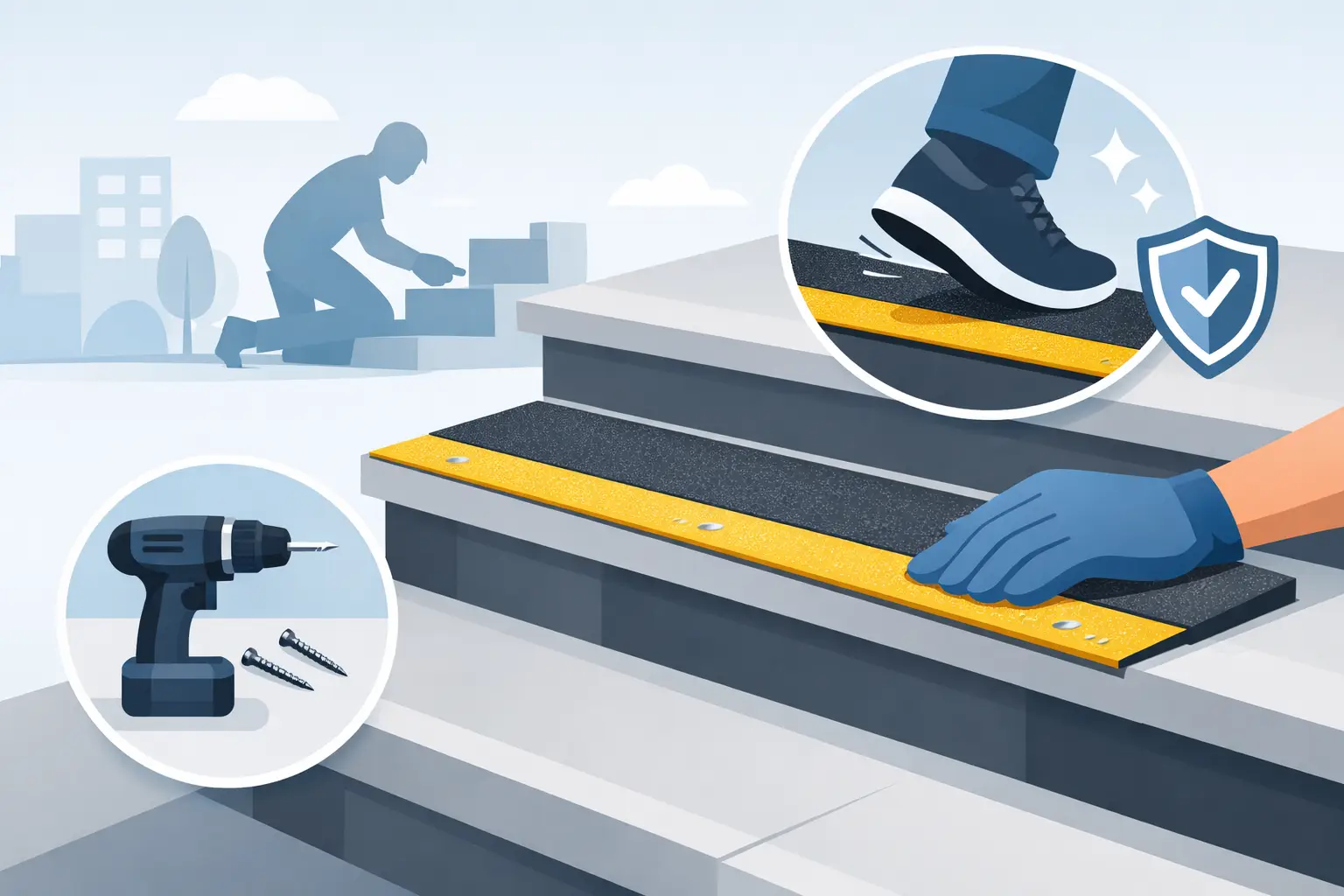
How to Install GRP Anti Slip Stair Treads
Learn how to install GRP anti slip stair treads safely and correctly for industrial stairs, with fixing methods, prep steps, and key checks.
A stair defect rarely announces itself before an incident. More often, the warning signs are already there worn nosings, standing water, oil carryover, coastal corrosion, or a surface that has polished smooth under constant foot traffic. When you install GRP anti-slip stair treads, the objective is not cosmetic improvement. It is a practical risk control designed to increase grip, improve edge visibility, and extend the service life of the underlying stair structure.
In industrial and infrastructure settings, that distinction matters. A tread installation on a plant access stair, offshore platform, quayside asset, or wind tower internal staircase must perform under contamination, weathering, and repeated loading. The right product helps reduce slip risk immediately, but long-term performance depends just as much on correct assessment, preparation, and fixing.
When to install GRP anti-slip stair treads
GRP stair treads are typically specified when an existing stair remains structurally sound but the walking surface has become unsafe. That may be due to corrosion, delamination of previous coatings, mechanical wear, or persistent exposure to water, grease, ice, drilling fluids, or general process contamination. In those cases, full stair replacement is often unnecessary and operationally disruptive. A properly selected GRP tread provides a faster upgrade path with lower installation burden.
This is especially relevant in environments where non-metallic materials bring an advantage. GRP composites do not corrode in the way steel components do, they are lightweight for handling on difficult access sites, and they are suited to harsh marine, chemical, and weather-exposed locations. For operators managing long-life assets, that has direct lifecycle value as well as safety benefit.
There is, however, an important qualification. Stair treads are not a substitute for structural repair. If the substrate is significantly deformed, fractured, unstable, or no longer capable of supporting load, the base stair must be repaired or replaced before any anti-slip system is fitted.
Assess the stair before installation
Before any material is cut or fixed, the stair should be surveyed properly. The first question is substrate type. GRP anti-slip stair treads can be installed over steel, concrete, timber, and some existing stair surfaces, but the fixing method will vary accordingly. On corroded steel, for example, the degree of section loss matters. Surface corrosion can often be managed through preparation, while advanced corrosion around edges or fix points may rule out direct installation until remedial works are completed.
Dimensions should be checked tread by tread rather than assumed from drawings. Industrial stairs are frequently inconsistent, particularly on older assets. Measure width, going, nosing profile, rise variation, and any obstruction such as stringer bolts, weld build-up, drainage cut-outs, or existing edge plates. If the product includes a high-visibility nosing, alignment becomes more than an aesthetic issue it supports safe foot placement and stair definition.
Environmental exposure also needs consideration. External stairs in coastal or process-heavy sites may require a more aggressive abrasive surface than internal access stairs in dry service areas. The best specification depends on contamination profile and cleaning regime. A coarse anti-slip finish improves grip in severe conditions, but there can be a trade-off with ease of cleaning and comfort under lighter-duty traffic.
Preparing the substrate properly
Most installation problems begin before fixing starts. If the substrate is dirty, unstable, or uneven, even a high-performance tread can fail prematurely.
The surface should be cleaned back to a sound condition. That usually means removing loose corrosion, failed coatings, debris, oils, salts, and any friable material. On steel stairs, mechanical preparation is often sufficient for cover installation, provided the remaining base is stable. On concrete, laitance, loose spalling, and contamination should be addressed. On timber, any rot, softness, or fix failure must be corrected before proceeding.
Flatness matters more than many teams expect. GRP treads need consistent bearing across the base. Local high spots can create rocking, while voids beneath the tread can lead to movement under traffic. If the stair profile is uneven, packers or local repairs may be required to achieve stable support. The aim is firm contact without distortion of the GRP section.
Dry fitting before final installation is good practice, particularly where access windows are tight or stairs are irregular. It allows hole locations, edge clearances, and nosing lines to be checked without committing to the fix.
How to install GRP anti-slip stair treads
The exact method depends on product design and substrate, but most installations follow a straightforward sequence: measure, cut, position, drill where required, and mechanically fix.
Cutting and positioning
GRP treads should be cut accurately to suit the stair width and any local obstructions. Clean, square cuts support better fit and reduce installation time on the structure. Once cut, each tread should be placed in position and checked for full seating, front edge alignment, and side clearance. It should sit securely without forcing.
If the stair has a pronounced existing nosing or irregular front edge, confirm that the GRP tread profile accommodates it correctly. Some cover systems are designed to wrap the nosing, while others sit back from the edge. Product geometry should always match the application rather than being adapted on site beyond recommended tolerances.
Fixing method
In most industrial applications, mechanical fixing is the primary attachment method. Stainless steel fixings are commonly selected where corrosion resistance is required, particularly on external or marine assets. The number and spacing of fixings depend on tread size, substrate condition, and loading requirements. They should be sufficient to prevent lift, movement, or drumming under traffic.
On steel stairs, fixing may be through pre-drilled holes into the base tread or via suitable self-drilling or bolted arrangements, depending on access and substrate thickness. On concrete, appropriate anchors are generally used. Adhesive-only installation is rarely suitable for high-consequence industrial stairs, especially in wet, contaminated, or temperature-variable environments. Where adhesives are used at all, they are typically supplementary rather than the sole means of retention.
Over-tightening should be avoided. GRP is durable, but fixings should clamp the tread securely without inducing unnecessary stress or crushing the laminate. Consistent torque and correct washer use help maintain a stable installation.
Installation details that affect long-term performance
A tread system can appear properly installed and still underperform if small details are missed. Drainage is one of them. If water or process fluid is allowed to pond at the rear or beneath the tread, contamination can accumulate and accelerate degradation of the base stair. The installation should allow the stair to shed water naturally rather than trapping it.
Edge finishing is another factor. Exposed cut edges should be left clean and neat, and any site modifications should remain within product guidance. Fixings should be positioned to avoid weakening critical areas close to edges or corners.
Consistency across the full staircase is equally important. A mixed arrangement of tread depths, nosing positions, or visible lines can reduce safe stair perception, especially in low light or emergency egress conditions. On safety-critical routes, visual uniformity is part of the control measure.
Common errors during GRP tread installation
The most frequent mistake is treating stair treads as a simple maintenance item rather than an engineered safety upgrade. That mindset leads to shortcuts measuring only the first step, fixing into unsound steel, ignoring contamination beneath the tread, or selecting a product grade unsuited to the exposure.
Another common issue is poor substrate diagnosis. If the underlying stair is already moving, cracked, or significantly corroded, the tread may mask the defect temporarily without resolving the hazard. The result is recurring maintenance and a false sense of compliance.
There is also a specification risk. Not every anti-slip surface is appropriate for every site. A refinery access stair, wastewater structure, and office plantroom do not present the same contamination profile or traffic type. Product selection should follow the hazard, not just the dimensions.
Final checks before the stair is handed back
Once installed, each tread should be checked for secure fixing, correct alignment, full seating, and absence of movement under load. Walk the stair. Look for rocking, edge lift, inconsistent nosing lines, or any fixing that has not seated properly. If the route is part of a controlled area, record the installation method and product specification for maintenance and compliance records.
For sites managing multiple access systems, it also makes sense to review adjacent hazards at the same time. Upgrading stairs while leaving slippery landings, exposed ladder rungs, or degraded walkway covers in place only solves part of the problem. A joined-up approach usually delivers better incident reduction and less repeated access disruption.
Where a project calls for application-led support, datasheet review and site-specific product matching are worth the time. Real Safety supports these types of upgrades across industrial stairs, walkways, ladders, and escape routes through engineered GRP anti-slip systems suited to harsh operating conditions.
A well-installed tread should do its job quietly for years: stable underfoot, visible at the edge, resistant to the environment, and one less slip hazard competing for attention on a demanding site.
Similar Articles

Stair Nosings That Stand Up to Industry
Choosing stair nosings for industrial steps: materials, fixings, slip resistance, corrosion, compliance and installation details for harsh sites.
Slip Rating for Industrial Stairs
Find out what slip rating is needed for industrial stairs, how P ratings apply, and when stair nosings, treads or GRP covers are the safer choice.

Dropped Object Barriers That Hold Up Offshore
Dropped object prevention barriers reduce line-of-fire risk on rigs, decks and assets. Learn where they fit, materials, and what to specify for compliance.