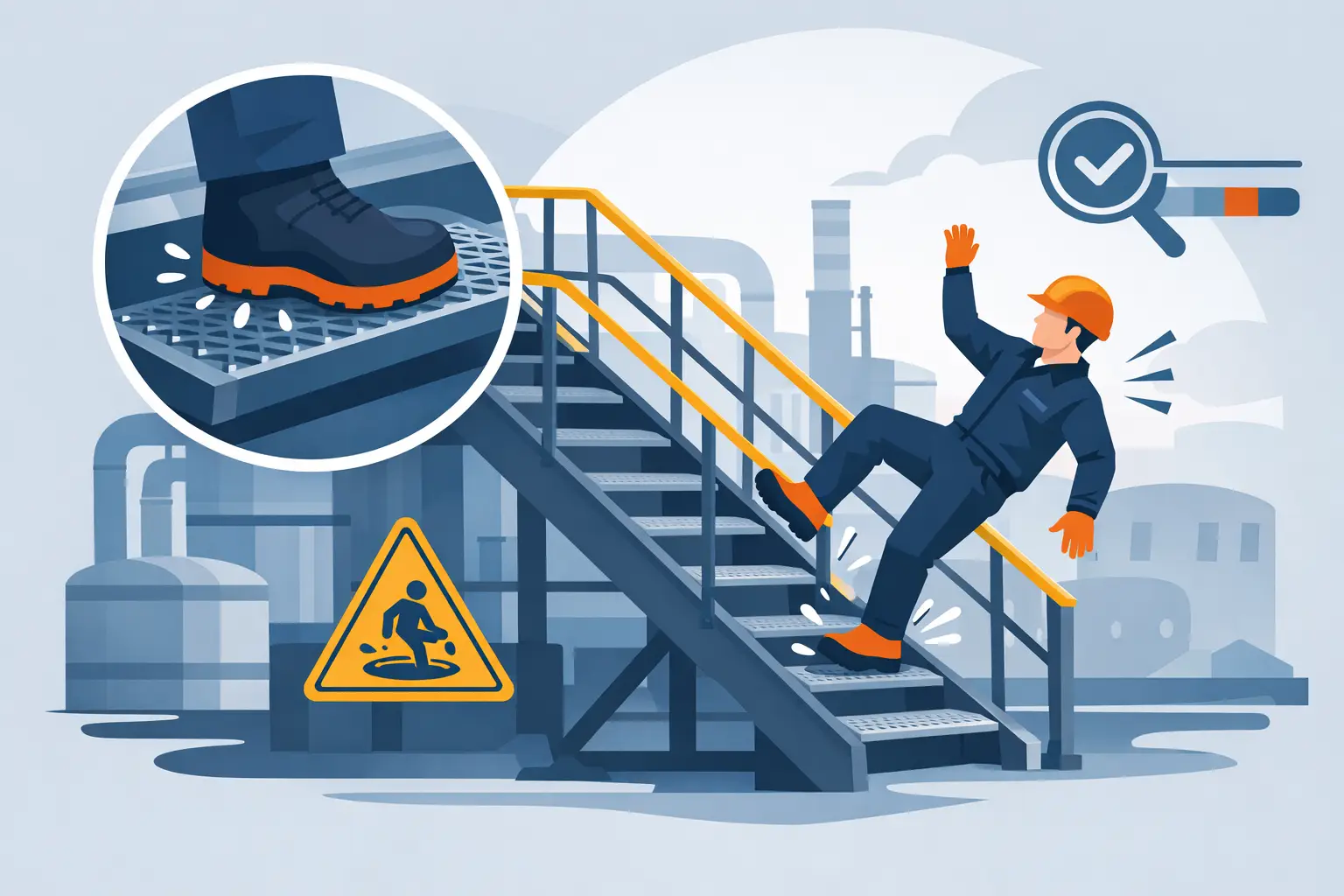
Slip Rating for Industrial Stairs
Find out what slip rating is needed for industrial stairs, how P ratings apply, and when stair nosings, treads or GRP covers are the safer choice.
A stair tread that performs well in a dry office block can become a liability on a quay, a rig access tower or a food processing plant stairwell. That is why the question is rarely just what slip rating is needed for industrial stairs. The real question is what level of slip resistance is needed on this stair, in this contamination, under this duty cycle.
For most industrial environments, the practical benchmark is a high slip resistance classification, typically a Pendulum Test Value aligned with low slip potential, and in many specifications that leads buyers towards products tested to P4 or P5 under the HSE-style ramp classification approach. On stairs exposed to water, oil, grease, frost, washdown or marine spray, P5 is often the safer and more defensible target. But rating alone is not enough. Geometry, edge definition, drainage, wear rate and installation method all affect whether a stair remains safe over time.
What slip rating is needed for industrial stairs?
If you are writing a specification or reviewing a risk assessment, the short answer is this: industrial stairs generally require a high slip resistance finish, and higher-risk sites should favour systems that achieve P5 slip resistance in testing.
That said, there is no single universal legal figure that applies to every industrial stair in every setting. The correct level depends on use conditions. A dry internal plant stair used by trained staff in controlled footwear presents a different risk profile from external steel stairs on an offshore asset or access steps in a bottling hall subject to frequent washdown.
In practice, many duty holders look for products with proven anti-slip performance rather than the minimum acceptable rating. That is the right approach. Stairs are a high-consequence area because a loss of footing rarely ends with a simple stumble. A fall on steps can escalate into serious injury, lost time incidents and avoidable enforcement scrutiny.
Why P4 and P5 matter on stairs
Slip ratings are often discussed using ramp test classifications such as P1 to P5. The higher the rating, the greater the slip resistance under test conditions. For industrial stairs, P4 may be acceptable in some lower contamination environments, but P5 is typically preferred where conditions are harsh, variable or persistently wet.
This matters because stairs concentrate load onto the leading edge of the foot. Users are changing level, shifting balance and relying on a smaller contact area than they would on a level walkway. Add contamination and the margin for error narrows quickly.
A high ramp classification should still be read alongside other data. Pendulum results, surface profile, abrasive media and expected wear all tell you more about how the product will behave once it is installed. A new anti-slip cover that tests well in the laboratory but loses its aggregate or edge visibility in service is not a strong control measure.
The environment decides the real requirement
The best specification starts with the contamination and exposure profile.
In energy and maritime settings, stairs may be exposed to hydrocarbons, drilling residues, saltwater, rain and wind-driven debris. In those cases, a coarse, durable anti-slip surface with strong drainage characteristics is usually necessary, and P5-rated stair tread covers or nosings are often justified.
In food, pharma and process sites, contamination may be water, syrup, oils, cleaning chemicals or powders. Hygiene and cleanability matter alongside grip. A profile that traps residue can create a secondary issue, so the product has to balance slip resistance with maintenance practicality.
For infrastructure and public assets, footfall is often high and user behaviour is less controlled. People may be carrying bags, rushing, or wearing a wide range of footwear. Here, visual contrast at the stair edge and long-term wear resistance are just as important as the headline slip rating.
What standards and test methods should you look at?
When buyers ask what slip rating is needed for industrial stairs, they are often really asking which test evidence is credible enough to support a compliance decision.
The answer is to avoid relying on a single number in isolation. Ramp classifications such as P ratings are useful because they are familiar and easy to compare, but they should be supported by recognised slip testing and product data. Pendulum testing remains highly relevant because it helps indicate slip potential, particularly when assessed in conditions representative of actual use.
You should also look for evidence of durability. An anti-slip stair solution is not a one-week fix. It needs to maintain performance under traffic, impact, cleaning and weather exposure. For industrial buyers, lifecycle performance is often more valuable than an impressive initial test result.
Stair nosing, tread cover or full stair replacement?
The required slip rating cannot be separated from the product format.
If the existing stair is structurally sound, retrofit stair tread covers or step covers are often the most efficient route. They can deliver high slip resistance, improved edge definition and fast installation without taking the stair out of service for major rebuild works. That is especially useful on live assets where downtime is expensive.
Nosings can be effective where the main risk sits at the leading edge and the body of the step remains in reasonable condition. However, on heavily worn steel, timber or concrete stairs, partial treatment may leave inconsistent grip across the tread.
Full replacement may be appropriate where corrosion, deformation or drainage failure means the substrate itself is no longer fit for purpose. In aggressive environments, GRP stair systems offer an advantage because they are non-corrosive, lightweight and non-conductive, with anti-slip surfaces engineered into the system rather than added as an afterthought.
Common specification mistakes
One common mistake is specifying a slip rating based only on procurement convenience. A buyer selects a generic anti-slip product because it is available quickly, but the product was developed for light commercial use rather than industrial duty. The result is usually early wear, poor bonding or inadequate resistance under contamination.
Another issue is ignoring the full stair assembly. Even if the tread surface tests to P5, poor fixing, uneven step dimensions, missing visual contrast or ponding water can still create a significant fall risk.
There is also a tendency to treat internal stairs as low risk. In reality, process condensation, tracked-in rainwater, overspray and cleaning regimes can make enclosed industrial stairs just as hazardous as external access routes.
How to decide what your stairs need
Start with a site-specific assessment. Look at contamination type, frequency of wetting, cleaning methods, traffic volume, footwear, incline, exposure to weather and the consequence of a fall. From there, specify the highest practical level of slip resistance that can be maintained in service.
For low-contamination internal stairs, a lower classification may satisfy the risk profile, provided testing and maintenance controls are strong. For most industrial applications, though, the safer position is to specify a high-performance anti-slip system from the outset. In wet, oily, marine or outdoor environments, that usually means treating P5 as the target rather than the upgrade.
It is also worth checking whether the product has been used successfully in comparable sectors. A stair cover that performs well in a shopping centre is not necessarily the right answer for a desalination plant or turbine access platform. Application evidence matters.
For organisations looking to reduce incident exposure without major structural works, retrofit GRP anti-slip stair solutions are often the strongest option. They can be installed onto existing substrates, improve underfoot stability immediately and offer long service life with minimal maintenance. For HSE managers and engineering teams, that makes the control measure easier to justify on both safety and cost grounds.
If you need a working rule, use this one: industrial stairs should not be specified to the minimum rating you think you can defend. They should be specified to the highest rating that matches the real environment and remains durable under service conditions. That is usually where safer stairs, fewer incidents and better lifecycle value meet.
Where uncertainty remains, it is worth reviewing the stair as an application rather than a product line item. The right answer is not simply a rating on a datasheet. It is a tested, durable system that keeps people stable on the step they actually use every day. For more application-led guidance, Real Safety at https://Realsap.com focuses on anti-slip and GRP systems built for exactly that kind of operating reality.
Similar Articles

Choosing an Anti Slip Safety Provider
Choose an anti slip safety solutions provider that delivers compliance, proven grip, low downtime and long service life in harsh environments.

Dropped Object Netting That Actually Controls Risk
Dropped object prevention netting reduces falling-object risk on rigs, wind and industry. Learn where it fits, how to specify it, and avoid gaps.

GRP Ladder Cable Trays for Harsh Sites
GRP cable tray ladder type systems reduce corrosion risk, weight and maintenance in harsh sites. Learn selection factors and applications.