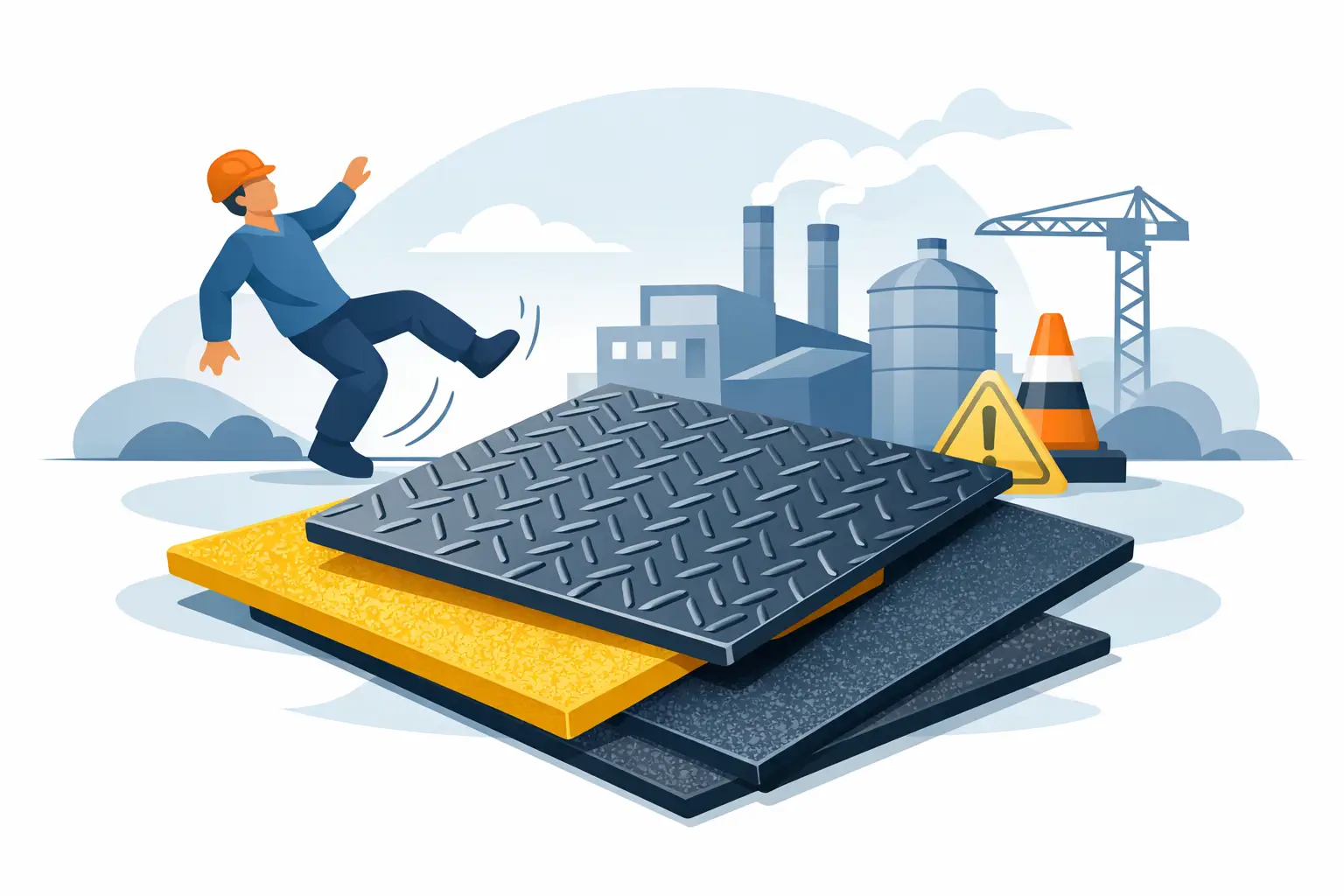
Anti Slip Floor Plates for Industry
Anti slip grp floor plates for industry reduce slips, corrosion issues and downtime across harsh sites with durable, compliant surface upgrades.
A painted steel deck can look serviceable during inspection and still become a high-risk walking surface within hours. A light film of oil, salt spray, process residue or rain is enough to turn routine access into an incident pathway. That is why anti slip floor plates for industry are specified not as cosmetic upgrades, but as engineered risk controls for work areas where traction, durability and compliance must hold up under real operating conditions.
In heavy industry, floor-level hazards are rarely static. Surface contamination changes by shift, by weather and by process. Foot traffic varies from occasional access to constant movement by operators carrying tools, hoses or components. In many sites, the challenge is not simply finding a product with a rough top surface. It is selecting a plate system that can be fixed over existing substrates, resist corrosion, maintain slip performance over time and avoid creating new maintenance problems.
Where anti slip floor plates for industry make the most difference
The highest value applications are usually the least forgiving ones. Offshore modules, marine walkways, loading areas, rig access routes, platforms around pumps and valves, food production corridors, water treatment assets and external stair landings all combine moisture with frequent traffic. In these settings, a slip is not just a minor injury event. It can lead to dropped tools, shutdowns, contamination, restricted access or secondary falls from height.
This is why specification should start with the area of use rather than the product name. A floor plate on a vessel deck faces saltwater, washdown and fuel residue. A plate in a chemical dosing area faces corrosive splash and aggressive cleaning regimes. A plate in a public concourse may face less chemical exposure, but higher footfall and stronger visual requirements for route definition. The operating context changes the right answer.
Material choice matters more than surface texture alone
Traditional metallic chequer plate is often assumed to provide enough grip by profile alone. In practice, its slip resistance can fall short when contamination is present, particularly once wear, paint build-up or corrosion affect the surface. Raised pattern does not automatically mean reliable underfoot performance.
For many industrial upgrades, GRP-based anti-slip systems offer a more dependable route. A properly engineered GRP plate combines an aggressive mineral surface with a non-metallic substrate that does not corrode, is lightweight for installation and remains suitable in electrically sensitive environments. That combination is especially relevant where steel replacement is costly, access is difficult or shutdown windows are short.
There are trade-offs. Steel can still suit some heavy impact environments where structural load and mechanical abuse dominate the specification. But where the brief is to improve traction over an existing floor without introducing corrosion risk or major fabrication work, anti-slip GRP plate systems are often the better lifecycle option.
Why GRP plates are widely specified
The appeal is not one feature but the way several performance requirements come together. GRP plates are lightweight, which reduces handling complexity during retrofit. They are non-corrosive, which matters in maritime, process and washdown areas. They are non-conductive, which can support safer access around electrical infrastructure. They also allow installation over existing substrates, helping sites avoid full deck replacement.
That matters commercially. A surface upgrade completed during a planned maintenance window is very different from removing and rebuilding a platform deck. Buyers focused on total cost should look beyond purchase price and consider labour, downtime, permits, hot works, future repainting and inspection frequency.
Key specification points before you buy
Slip resistance is the first requirement, but not the only one. The plate must also match the substrate, the fixing method and the exposure profile. A good specification review should cover surface contamination, temperature range, cleaning regime, traffic type, expected service life and whether the plate is acting as a cover or contributing structurally.
Thickness and panel size need careful attention. Overspecifying adds weight and cost. Underspecifying can lead to movement, cracking or premature edge damage. In retrofit applications, fixing detail is often where good projects succeed or fail. Mechanical fixings, adhesive systems or a combined approach may all be suitable depending on the base material and service conditions.
It is also worth checking edge treatment and visibility. In escape routes, stair landings and transition points, contrast can improve hazard perception. In hygiene-controlled areas, cleanability and resistance to repeated washdown may be as important as raw grip values.
Questions engineering teams should ask
Ask what the plate is being fixed to, what contaminant is most common and whether the area is internal, external or both. Confirm whether the substrate is steel, concrete, timber or existing grating. Check if hot work is restricted. Review whether the plate needs to bridge local defects or simply provide a new wearing surface. These details affect product selection far more than generic catalogue descriptions.
Sector-specific demands change the right solution
In energy assets, especially offshore and onshore oil and gas, anti-slip floor plates often need to perform in hydrocarbon-contaminated zones where corrosion and weathering are constant. Weight can also be a deciding factor, particularly on offshore platforms and wind structures where every kilogram influences installation and asset planning.
In maritime settings, salt exposure accelerates failure in conventional metallic surfaces and fixings. Anti-slip floor plates used on gangways, deck access points and service walkways need long-term resistance to marine conditions, not just initial grip.
For process industry and water treatment sites, chemical compatibility matters. Corrosive splash, standing water and frequent washdown quickly expose weak materials. Food and pharma environments add another layer, where surfaces must support safe movement without creating maintenance burdens or hygiene issues.
Public and infrastructure environments have their own priorities. High-footfall walkways, stations, stadiums and civic assets need durable anti-slip performance, but also clean installation, predictable maintenance and often visual demarcation for access routes.
Installation strategy affects whole-life value
The best anti-slip floor plates for industry are not only durable products. They are also practical to install on live or time-constrained sites. Retrofitting onto existing steel, concrete or timber can reduce disruption significantly when compared with full replacement works.
This is where engineered systems earn their value. Pre-sized plates, defined fixing patterns and substrate-specific recommendations reduce uncertainty on site. Shorter installation windows mean less interference with operations and fewer knock-on costs. In many projects, that is where the business case becomes clear.
A maintenance manager will also want to know what happens after installation. Surfaces that require regular repainting, corrosion treatment or patch repairs can erode the initial saving very quickly. By contrast, a maintenance-free or low-maintenance plate system supports safer access with less recurring intervention.
Compliance is part of the specification, not an afterthought
Buyers in regulated sectors need more than a product that feels grippy underfoot. They need documented performance, traceable materials and a supplier that understands the site consequences of getting specification wrong. Datasheets, test information and application guidance should sit alongside product selection from the start.
This is particularly true where anti-slip plates form part of a broader safety upgrade across stairs, walkways, ladders and escape routes. A piecemeal approach can solve one hazard while leaving adjacent access points inconsistent. A coordinated specification improves route continuity and makes maintenance simpler.
For organisations reviewing ageing access infrastructure, it often makes sense to assess the full movement path rather than isolated floor sections. Plate covers may resolve deck slip risk, but stair nosings, ladder rung covers or landing covers may be equally important to reduce incident exposure across the route.
Choosing a supplier with application experience
Industrial buyers rarely need a generic off-the-shelf recommendation. They need a supplier that can read drawings, understand substrates, recognise contamination risk and advise on installation constraints. Case-led experience matters because site conditions are rarely textbook.
That is the value of working with a specialist such as Real Safety, where anti-slip systems are not sold as standalone accessories but as part of a wider access and asset protection strategy. For engineering, HSE and procurement teams, that reduces the risk of specifying a product that looks suitable on paper but underperforms in service.
The strongest anti-slip floor plate solution is usually the one that fits the hazard, the asset and the maintenance model at the same time. When those three align, the result is not just better grip. It is fewer incidents, less downtime and a safer surface that keeps doing its job long after installation.
Similar Articles

Non Metallic Cable Trays for Industrial Environments
Non metallic cable trays for industrial environments. Discover the benefits of corrosion resistance, lower weight, electrical safety, and reduced maintenance.

GRP Grating vs Steel Grating: Which Is Safer for Your Workplace?
Choosing between GRP and steel grating? Compare safety, durability, maintenance, and performance for industrial environments.

How to Choose Drop Prevention Systems
Learn how to choose drop prevention systems for tool control with the right risk assessment, attachment method, load rating and site fit.