GRP Grating vs Steel Grating: Which Is Safer for Your Workplace?
Choosing between GRP and steel grating? Compare safety, durability, maintenance, and performance for industrial environments.
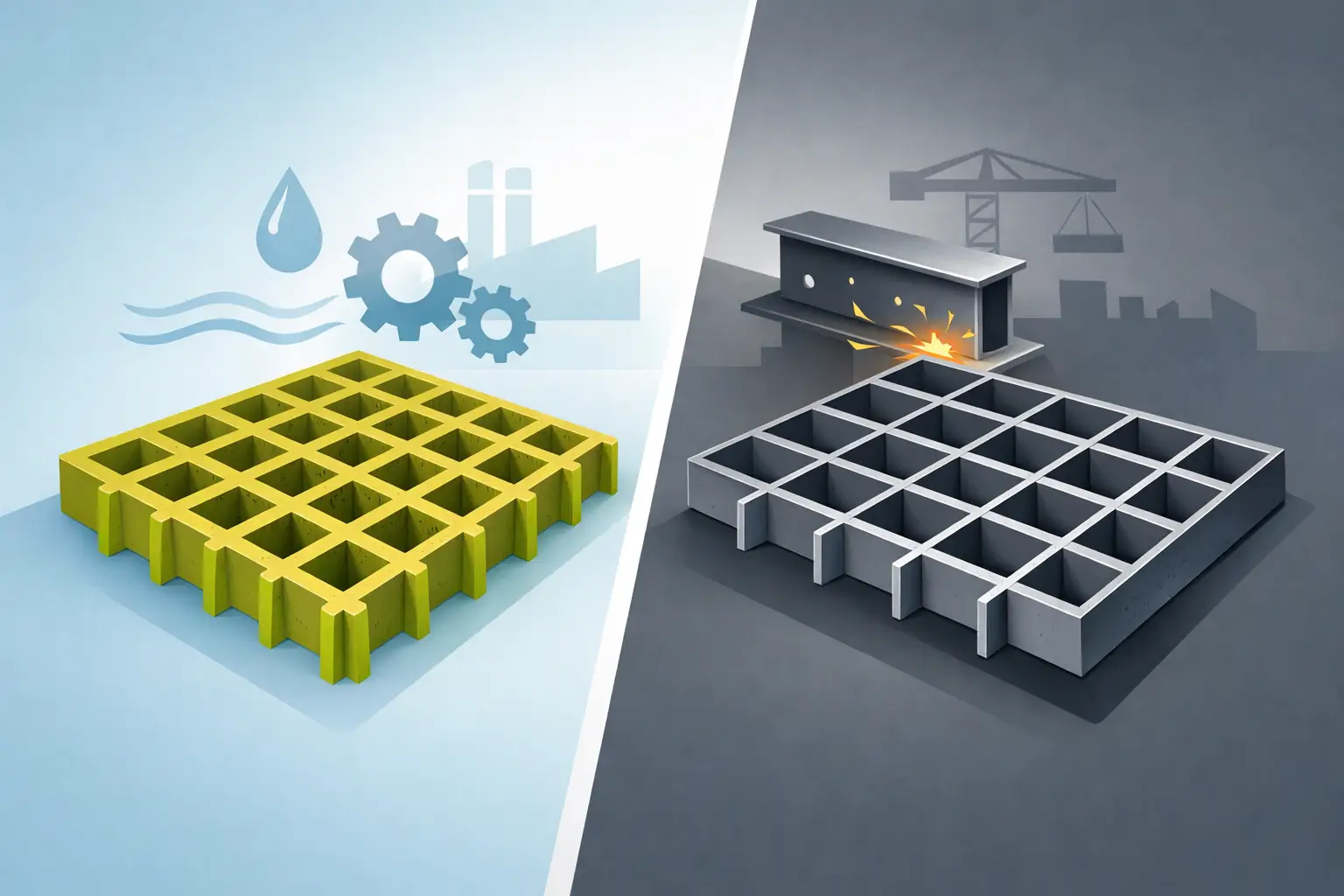
A grating specification rarely fails on paper. Problems appear later - when corrosion starts beneath coatings, when manual handling becomes a bottleneck, or when a wet access route still produces slip risk after maintenance spend. In that context, the choice of FRP grating vs steel grating is not simply a material preference. It is a risk, maintenance and lifecycle decision.
For HSE managers, engineers and procurement teams, the right answer depends on operating environment, load case, exposure profile and the cost of intervention over time. Steel remains a valid option in many installations. GRP composites, however, have become the stronger fit where corrosion, weight, conductivity and slip performance drive the specification.
GRP grating vs steel grating in working environments
Steel grating has long been used for platforms, walkways, trenches and stair landings because it offers familiar structural performance and can be designed for high loads and long spans. In benign environments, particularly where impact resistance and very heavy point loading are central concerns, galvanised or stainless steel can still be appropriate.
GRP grating is a non-metallic alternative manufactured from glass-reinforced plastic resins and reinforcements. In industrial safety applications, its value is not only that it replaces metal. Its value is that it changes the maintenance profile and hazard profile of the asset. It does not rust, it is lightweight, non-conductive and available with anti-slip surfaces suited to persistently wet, oily or chemically aggressive areas.
That distinction matters in sectors such as offshore energy, maritime, chemical processing, water treatment and food production, where grating is exposed to a combination of moisture, washdown, salt, chemicals and regular foot traffic.
Corrosion resistance is often the deciding factor
If the installation sits in a corrosive setting, FRP usually has the advantage. Saltwater, chemical splash, humidity and repeated washdown all attack steel over time. Galvanising delays deterioration, and stainless grades improve resistance, but neither removes the issue entirely. Once coatings are damaged or local corrosion begins around fixings, cut edges or welds, maintenance demand increases.
GRP grating does not suffer electrochemical corrosion in the way steel does. That makes it well suited to coastal assets, desalination plants, wastewater treatment works, battery rooms, chemical bunds and process areas where corrosive agents are part of normal operation. For asset owners, that means fewer shutdowns for repainting, replacement or remedial works.
This is also where lifecycle value becomes clearer. A lower upfront material cost can be offset quickly if steel requires repeated treatment, inspection and replacement in harsh service conditions. The more aggressive the environment, the less useful a simple purchase price comparison becomes.
Slip resistance and underfoot safety
Not all gratings perform equally when the hazard is underfoot rather than structural. In many facilities, slips and trips are the immediate risk driving upgrade programmes. Wet stairs, oily walkways, marine decks and plant access routes need stable footing, not only load-bearing capacity.
GRP grating is commonly supplied with integrally applied grit or moulded anti-slip surfaces that maintain traction in demanding conditions. This is one reason it is frequently selected for access platforms, walkways and escape routes where water, grease or process residue are present. Steel can also be serrated for improved grip, but performance depends heavily on the profile selected, the condition of the surface and how contamination builds over time.
There is also a practical point here. If steel corrodes, the walking surface can become less predictable. If coatings are added to improve corrosion resistance, they can alter surface performance or require renewal. With GRP, anti-slip performance is built into the grating specification from the outset.
Weight, installation and downtime
One of the clearest operational differences in GRP grating vs steel grating is weight. GRP is substantially lighter than steel, which affects everything from transport and site access to lifting plans and installation time.
For maintenance teams working in live plants, offshore modules or elevated structures, lighter components reduce handling effort and simplify replacement. In retrofit projects, this can help avoid major structural modification, especially where existing support steelwork has limited reserve capacity. On weight-sensitive assets such as offshore platforms, vessels and wind infrastructure, material weight is not a secondary issue. It can influence overall design efficiency and installation strategy.
Reduced weight can also mean reduced downtime. Panels are easier to manoeuvre, easier to cut on site where permitted, and often faster to install. When the objective is to upgrade a walkway, landing or platform without prolonged operational disruption, that matters.
Electrical and thermal properties
Steel is conductive. In some environments that is acceptable, but in others it introduces an avoidable hazard. Around electrical equipment, substations, rail infrastructure and specialist process areas, non-conductive walkway materials can support safer access design.
GRP offers electrical non-conductivity and lower thermal conductivity than steel. The result is a surface that can be better suited to applications where personnel may be working around electrical risk or where exposed metal surfaces become problematic in temperature extremes.
This does not mean GRP is universally the correct choice for every electrically sensitive area. The full specification still depends on load, fire performance requirements, chemical resistance and compliance criteria. But where conductive materials create additional exposure, GRP gives specifiers another control measure.
Strength, span and impact - where steel still earns its place
A balanced comparison should be clear about trade-offs. Steel generally offers higher absolute stiffness and can be preferable where very heavy loads, long unsupported spans or severe impact conditions dominate the design brief. In heavy industrial settings with concentrated loads from equipment or traffic, steel may remain the more practical answer.
FRP grating can be engineered for demanding industrial loads, but it should not be treated as a direct one-for-one substitution without checking span tables, deflection limits, support centres and load type. Pedestrian loading, trolley traffic, occasional maintenance access and process plant walkways are one thing. Repeated heavy vehicular loading or high-impact service may point elsewhere.
This is where application-led specification matters. The right question is not which material is better in general. It is which material performs best in the actual duty of the asset.
Fire, temperature and compliance considerations
Fire performance is another area where assumptions cause poor specification. Steel is non-combustible, while GRP relies on resin systems and formulations designed to meet relevant fire performance criteria. In many industrial applications, fire-retardant GRP grades are specified successfully, but project requirements must be checked carefully against the operating environment and applicable standards.
Temperature exposure also needs proper review. Very hot service conditions can affect resin-based materials differently from steel. Conversely, steel in exposed external environments may create handling and comfort issues due to heat gain or cold transfer. As ever, the answer depends on the service profile rather than product familiarity.
Maintenance burden and whole-life cost
Maintenance is where many grating decisions are won or lost after installation. Steel often demands a continuing regime of inspection, coating repair and corrosion management, especially in marine and process settings. That work has a direct labour cost and an indirect operational cost, particularly when access systems are critical to day-to-day movement.
GRP is often described as maintenance-free, and in practical terms it can be very low-maintenance compared with steel. It still requires inspection as part of any safety-critical asset, but the routine burden is typically lower because there is no rust treatment, repainting or galvanic deterioration to manage.
For procurement teams assessing value over ten or fifteen years, this changes the calculation. Material cost, installation cost, service life, downtime, replacement intervals and labour all need to be considered together. In corrosive or high-footfall environments, GRP often proves commercially stronger over the asset lifecycle even when the initial unit rate is not the lowest option.
Which material fits which application?
For dry internal plant areas with high loading and limited corrosion exposure, steel may still be entirely suitable. For offshore decks, ports, chemical plants, water treatment works, food production areas, external public walkways and washdown zones, GRP frequently offers a better balance of safety performance and lifecycle reliability.
That is especially true where the grating is part of a broader slip prevention strategy across stairs, landings, ladders and access routes. In those cases, selecting a non-corrosive, anti-slip and low-maintenance material helps create consistency across the whole pedestrian network rather than solving one local issue at a time.
For many industrial operators, the decision comes down to this: if corrosion, manual handling, conductivity and underfoot grip are active risks, GRP is often the more effective engineering control. If extreme load and impact conditions dominate, steel may remain the correct specification. The strongest projects are the ones that make that distinction early, using the actual site hazard profile rather than defaulting to legacy materials.
Where access systems are exposed to harsh service conditions year after year, a grating panel is never just a panel. It is part of the site's safety performance, maintenance demand and compliance position - and it deserves to be specified that way.
Similar Articles

Non Metallic Cable Trays for Industrial Environments
Non metallic cable trays for industrial environments. Discover the benefits of corrosion resistance, lower weight, electrical safety, and reduced maintenance.
Anti Slip Floor Plates for Industry
Anti slip grp floor plates for industry reduce slips, corrosion issues and downtime across harsh sites with durable, compliant surface upgrades.

How to Choose Drop Prevention Systems
Learn how to choose drop prevention systems for tool control with the right risk assessment, attachment method, load rating and site fit.