Anti Slip Nosings vs Full Stair Tread Covers
Anti slip nosings vs full tread covers - compare grip, coverage, install time and lifecycle value for safer stairs in industrial settings.
A stair incident rarely starts with a dramatic failure. More often, it starts at the leading edge of a step, on a worn substrate, or where water, oil, dust or frost has reduced underfoot grip below a safe margin. That is why the choice between anti slip nosings vs full tread covers matters. Both are proven stair safety controls, but they solve different risk profiles, and choosing the wrong one can leave exposure in place.
For HSE teams, maintenance managers and specifiers, this is not a cosmetic decision. It affects slip resistance, visual step definition, installation scope, downtime, substrate condition and whole-life cost. In industrial and infrastructure environments, where stairs are exposed to weathering, contamination and heavy traffic, the correct treatment should be selected on application, not habit.
Anti slip nosings vs full tread covers - the practical difference
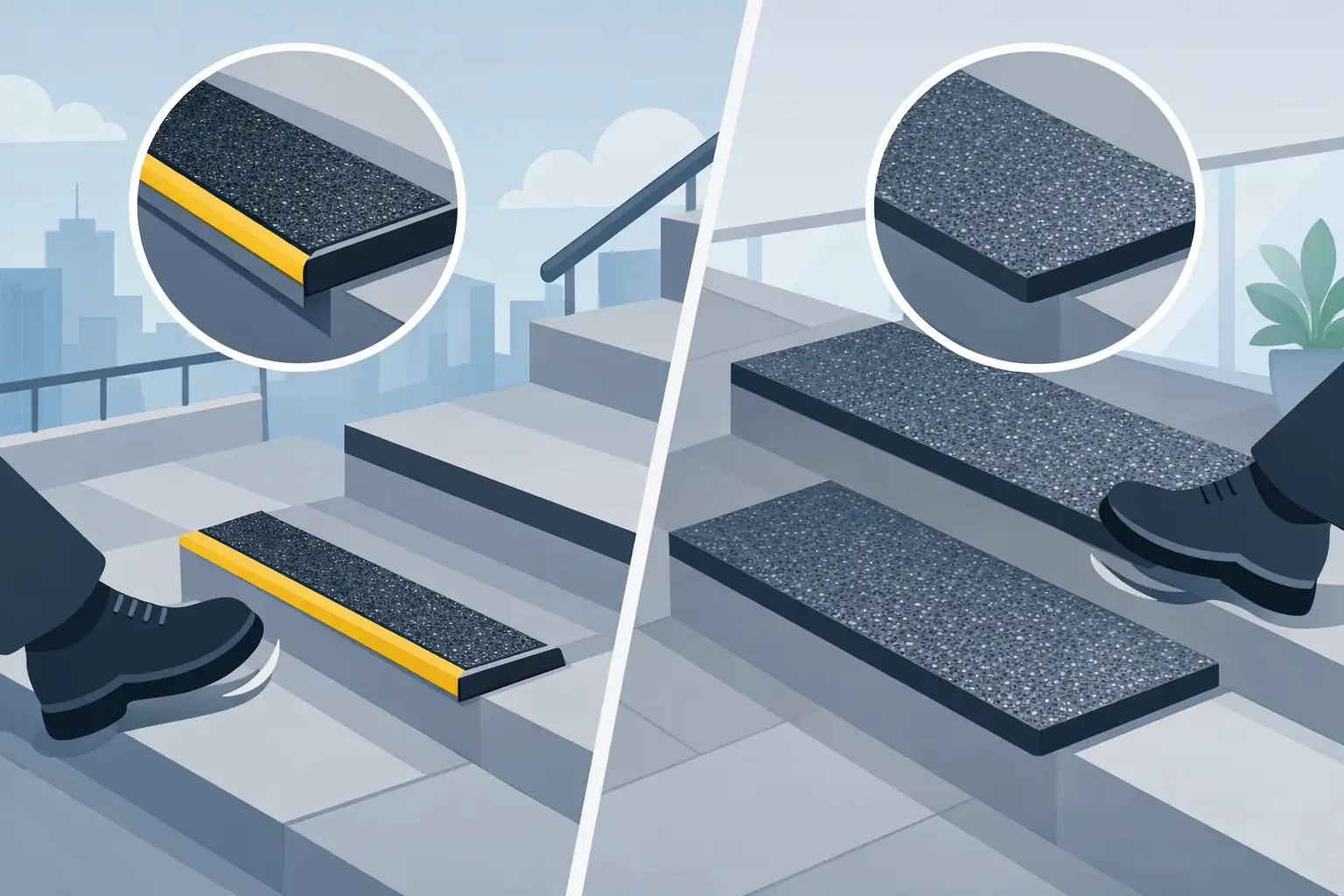
Anti slip nosings are fitted to the front edge of the step, where the highest concentration of foot contact typically occurs during ascent and descent. Their main function is to improve grip at the leading edge and provide clear visual delineation of the step line. This makes them particularly effective where the tread body remains structurally sound and the principal hazard is edge slip, worn nosing detail or poor step visibility.
Full tread covers, by contrast, protect and treat the entire top surface of each step. They deliver anti-slip performance across the whole walking area rather than only the front edge. In environments where contamination is spread across the tread, where existing surfaces are degraded, or where users may place their feet inconsistently, full coverage is often the stronger control measure.
The distinction sounds simple, but in practice it affects specification decisions across every sector. A ferry embarkation stair, a wastewater access platform and a public concourse escape route may all require different answers even when the same hazard category appears on paper.
When anti slip nosings are the right choice
Nosings are often the most efficient option when the step surface is fundamentally serviceable but the front edge has become the weak point. This is common on painted steel stairs, precast concrete steps and timber stairs in secondary access areas. If the existing tread is flat, stable and not heavily contaminated across its full width, a high-performance nosing can significantly improve safety without the cost or interruption associated with full-surface remediation.
They are also useful where fast installation is a priority. Because coverage is limited to the leading edge, installation is generally quicker and material usage lower. For facilities trying to upgrade active stairways during short shutdown windows, this matters. In some cases, it is the difference between a practical retrofit and a deferred safety project.
There is also a visibility advantage. Well-specified nosings can provide a contrasting front edge that helps users judge step depth and transition more accurately. In low-light areas, external stairs and mixed-user environments, that visual cue contributes to slip and trip reduction at the same time.
That said, nosings do not solve every stair problem. If water, grease, product residue or windblown debris covers the full tread, improving only the leading edge may not address the dominant hazard. They are best understood as a targeted control, not a universal one.
When full tread covers are the better control
Full tread covers become the stronger option when the hazard extends beyond the nosing line. Offshore stairs, marine gangways, process plant access routes and external industrial stairs often experience contamination across the full step. In these settings, users may step anywhere on the tread, pause mid-step, or descend while carrying tools or equipment. A full anti-slip surface gives more consistent underfoot performance over the entire contact area.
They also make sense where the underlying tread has deteriorated. Worn concrete, corroded steel chequer plate and delaminating painted surfaces may still be structurally usable but provide poor and inconsistent grip. A full tread cover can encapsulate that surface with a durable anti-slip layer and extend asset life without full stair replacement.
For sites focused on lifecycle value, this point is important. If a full tread cover avoids repeated patch repairs, repainting or reactive maintenance, the higher initial product cost can compare favourably over time. In many industrial settings, labour access, permits and downtime cost more than the anti-slip component itself.
Performance depends on contamination, not preference
The specification should start with what is on the stairs and how often it is there. Water behaves differently from oil. Fine dust behaves differently from wet organic matter. Marine salt spray, chemical residues and food processing by-products each change how a stair performs under load.
In relatively clean internal environments, a nosing may be sufficient if slip exposure is concentrated at the front edge. In harsh external or process-heavy areas, full tread covers often provide a wider safety margin because they are less dependent on precise foot placement. This is especially relevant on stairs used during maintenance activities, emergency egress or shift-change peaks, where behaviour is less controlled.
This is where GRP composites are particularly valuable. A properly engineered GRP anti-slip product offers corrosion resistance, low maintenance and stable performance in environments where metallic alternatives degrade or require frequent refurbishment. For energy, maritime and process industry operators, that non-metallic durability is often as important as the slip rating itself.
Installation, downtime and substrate condition
One reason anti slip nosings remain widely specified is practicality. They are lighter-touch to install and can be fitted onto many existing stair types with minimal disruption. If the project objective is a rapid risk reduction measure on otherwise acceptable stairs, nosings can be the sensible answer.
Full tread covers require more surface area preparation and more precise fitment. On irregular stairs, that can increase installation time. However, where the substrate is tired or inconsistent, full covers may actually simplify the long-term picture by creating a uniform tread surface across the staircase.
Substrate condition should always be checked before either system is installed. Neither nosings nor tread covers should be treated as a substitute for structural integrity. If the stair is unsound, anti-slip products are not the remedy. But if the stair remains structurally viable and the issue is slip resistance or localised wear, retrofit systems can upgrade safety quickly and avoid costly replacement.
Cost should be measured over service life
If the comparison is reduced to purchase price alone, nosings will often appear more economical. They use less material and typically install faster. For low-risk or lightly contaminated stairs, that may be the right commercial and operational decision.
But whole-life cost tells a fuller story. Full tread covers may reduce maintenance interventions, improve durability on heavily trafficked stairs and provide broader risk control in demanding conditions. On sites where access is difficult or permit-to-work requirements are strict, avoiding repeat attendance can outweigh the difference in upfront spend.
This is particularly relevant in offshore, coastal and chemical environments. Corrosion, weathering and contamination accelerate surface failure. A system that lasts longer with less intervention supports both budget control and compliance.
Anti slip nosings vs full tread covers in different sectors
In energy and process settings, full tread covers are frequently preferred on external stairs, exposed platforms and routes subject to hydrocarbons, washdown or chemical splash. The wider coverage aligns better with the contamination profile.
In maritime environments, the answer depends on location. Internal vessel stairs in controlled areas may suit nosings, while exposed access routes and embarkation points often justify full tread coverage due to saltwater, fuel residue and constant moisture.
In public and infrastructure applications, visual delineation can weigh more heavily in the decision. Nosings can perform well where the stair body is in good condition and user safety benefits from a clearly marked leading edge. But on transport assets and outdoor public stairs exposed to rain, leaf matter and winter conditions, full tread covers may provide a stronger and more durable control.
In food and pharma, hygiene and washdown regimes influence the choice. If the full step is routinely wet, the argument for full coverage strengthens. If contamination is controlled and the main issue is worn front edges, nosings can still be appropriate.
How to choose correctly
The right question is not which product is better in general. It is which control best matches the stair, the contamination, the traffic pattern and the maintenance reality. A good specification should consider where the slip occurs, whether the entire tread is affected, how degraded the substrate is, how much shutdown time is available, and what service life is expected.
An application-led assessment usually produces the clearest answer. That is why experienced suppliers do not treat stairs as a single category. Different access routes on the same site may require different interventions, and a mixed approach is often the most efficient. Real Safety works in exactly these conditions, where compliance, durability and downtime all need to be balanced against a real operational hazard.
If the leading edge is the problem, anti slip nosings can be precise, cost-effective and fast to deploy. If the whole step is the problem, full tread covers generally provide the stronger control. The safest choice is the one that reflects how the stair is actually used on site, not how it looks on a drawing.
Similar Articles

Non Metallic Cable Trays for Industrial Environments
Non metallic cable trays for industrial environments. Discover the benefits of corrosion resistance, lower weight, electrical safety, and reduced maintenance.

GRP Grating vs Steel Grating: Which Is Safer for Your Workplace?
Choosing between GRP and steel grating? Compare safety, durability, maintenance, and performance for industrial environments.

Anti Slip Floor Plates for Industry
Anti slip grp floor plates for industry reduce slips, corrosion issues and downtime across harsh sites with durable, compliant surface upgrades.