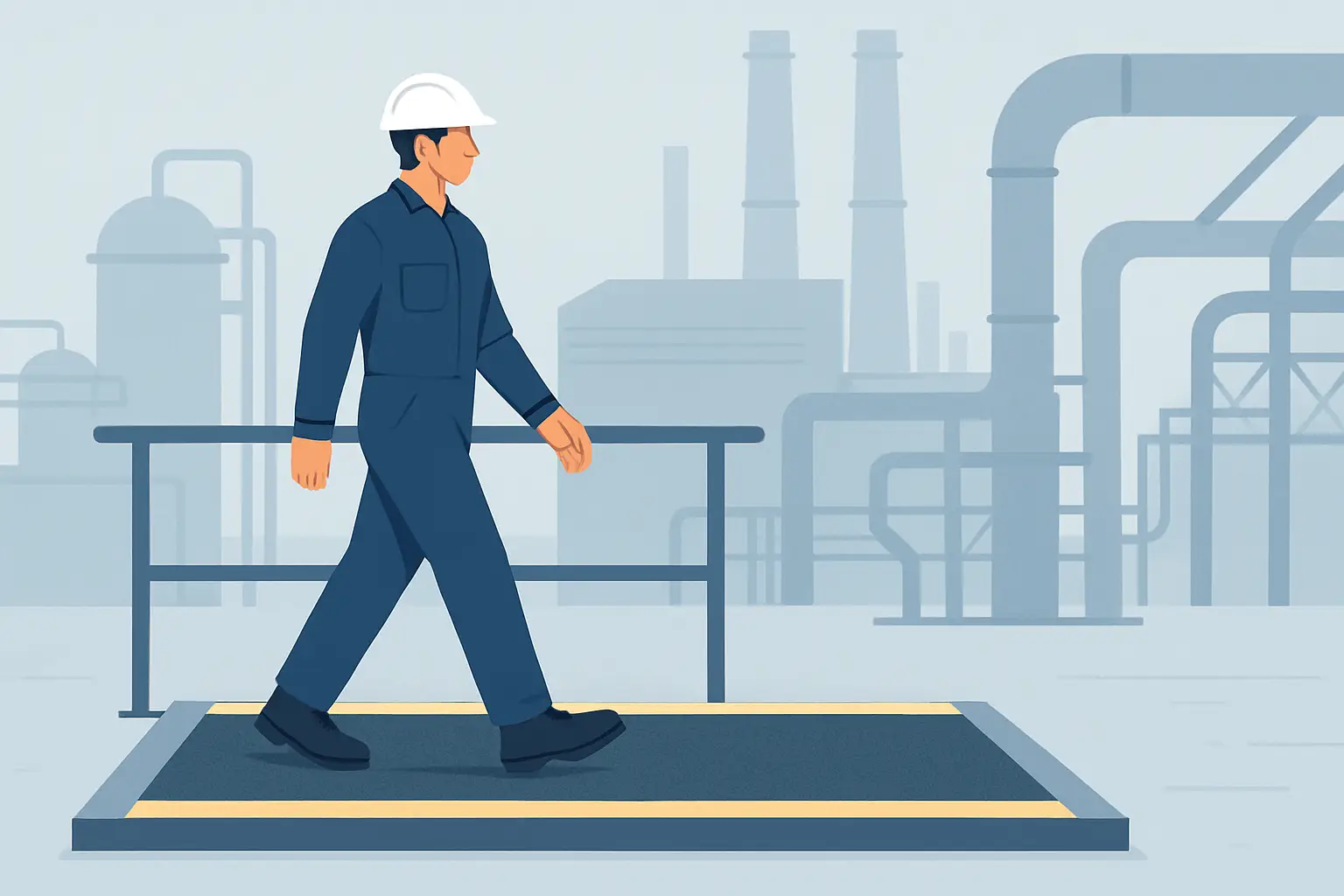
Anti-Slip Walkway Covers for Heavy Industry
Anti slip walkway covers for industry reduce slips in harsh sites. Learn materials, fixings, compliance and selection for long-life, low upkeep control.
A wet steel deck at 06:00, salt spray still in the air, boots carrying drilling mud from the last task - that is when a “standard” walkway surface quietly stops being standard. In heavy industry, slip risk rarely comes from one dramatic failure. It comes from repeated exposure: water, hydrocarbons, dust, algae, ice, vibration, worn coatings, rushed access, and the reality that walkways are used all day, every day.
Anti slip walkway covers for industry are a practical risk control because they target the contact surface itself. They can be installed over existing substrates with limited disruption, and when specified properly they keep grip where paints, tapes, and ad-hoc patches typically degrade.
What walkway covers actually do (and what they do not)
Walkway covers are not a cosmetic upgrade. They are an engineered interface between the user and the structure: a textured, high-friction walking surface designed to maintain traction when contaminated, and to remain stable under foot traffic and mechanical cleaning.
They do not, by themselves, remove the need to manage contamination at source. If a route is routinely flooded with oil mist, or wash-down procedures leave standing water, you still need drainage, housekeeping, and controls around the process. The value of a cover is that the residual risk - what remains after those controls - is materially lower because the surface continues to bite.
Why GRP composite walkway covers are common in harsh environments
For many industrial sites, GRP (glass-reinforced plastic) composites are a rational choice for walkway covers because the material behaviour matches the operating conditions. GRP is non-metallic and non-corrosive, so you avoid the predictable lifecycle issue of steel plate solutions in coastal, marine, chemical, and wet processing environments.
GRP is also lightweight. That matters on offshore assets, platforms, and wind structures where weight is not just a handling issue but a design constraint. It also matters for maintenance teams working in restricted access areas - fewer lifting aids, faster change-outs, and less downtime.
The trade-off is temperature and fire performance requirements. Depending on the site, you may need a specific resin system, smoke/toxicity performance, and documented test data. Where hot work, high radiant heat, or process temperatures are present, specification needs to be deliberate. “Composite” is not a single performance category.
Grit, profiles, and drainage: what creates slip resistance
Most industrial anti-slip walkway covers rely on a hard aggregate grit bonded into the surface, often on a GRP base. That grit is doing the work, not a superficial texture.
The right surface depends on the contamination regime. In dry, dusty environments you may prioritise a profile that sheds fines and stays cleanable. In wet areas - seawater, spray, wash-down, rain - you want an aggressive surface that keeps friction when the tread is flooded. In oily zones, you need to be realistic: any surface can be overwhelmed by heavy oil films, so you will lean on drainage, matting at transitions, and cleaning, with the cover specified to retain grip after repeated degreasing.
Drainage is often overlooked. A cover that traps water can underperform even if the grit is aggressive. Where the substrate is flat and pooling is expected, consider how water will escape, and whether a raised profile or open construction is more appropriate.
Fit-for-purpose selection: the questions that matter on site
Procurement teams often start with dimensions. Engineering teams should start with conditions.
Ask what the walkway is made of (chequer plate, smooth steel, concrete, grating), and what its current condition is. A cover installed over heavily corroded steel is not a fix for structural loss - it is a slip control only. Confirm whether there is movement or vibration that will work fixings loose over time, particularly on rotating or high-vibration assets.
Then map contamination and traffic. Is it boots only, or will trolleys, pallet lorries, or small plant cross the area? Wheel traffic changes the surface requirement and the fixing strategy, and it can accelerate wear on high-aggression grits. If there is a defined escape route, treat it as a separate requirement: it must remain passable in worst credible conditions, not average conditions.
Finally, look at interfaces. Many incidents occur at transitions: onto stairs, across thresholds, or where a cover ends and a painted deck begins. A good design includes consistent friction across the route, avoids trip edges, and uses nosings or edge profiles where required.
Fixings and installation: performance is only as good as restraint
Walkway covers fail in two ways: they lose friction because the surface wears or becomes fouled, or they lose restraint because the fixing method was not matched to the substrate and environment. In industry, restraint is not optional. Adhesive-only approaches can be suitable in controlled environments, but on exposed assets, fixings that resist peel, shear, vibration, and thermal movement are usually the safer engineering decision.
Mechanical fixing to steel must consider corrosion couples and long-term maintenance access. Non-metallic systems remove many corrosion problems, but fasteners still need correct material selection for the environment. On concrete, pull-out strength and edge distances matter, particularly where spalling is already present.
Installation planning should also consider downtime. Covers that can be supplied pre-cut to suit walkway widths, penetrations, and equipment bases reduce hot work and site cutting. Where hot work permits are difficult to obtain - common on offshore and high-regulation facilities - that can be the difference between a scheduled upgrade and a postponed one.
Compliance and evidence: what HSE teams will want to see
Slip controls are rarely accepted on claim alone. HSE and engineering stakeholders typically look for three forms of evidence.
First, friction or slip resistance performance with clear test methodology. Second, material data: chemical resistance, UV behaviour if external, and any fire performance documentation required by the asset. Third, service history in comparable sectors. For high-consequence environments, “it has worked elsewhere” needs to be grounded in documented application, not anecdote.
If the walkway is part of an egress route, you also need to take a more conservative stance on maintainability and inspection. A product that performs well when clean but is difficult to inspect, or is easily damaged by routine cleaning equipment, can introduce hidden degradation. The right cover makes inspection straightforward: edges visible, fixings accessible, and wear indicators practical.
Typical industrial use-cases where covers pay back quickly
Walkway covers tend to justify themselves fastest where there is a repeated wetting cycle or a known contamination source. Offshore and coastal assets are obvious because salt spray and algae create persistent low-friction films. On rigs and drilling environments, mud, brine, and hydrocarbon contamination is routine, and walkways are trafficked under time pressure.
In renewables, weight sensitivity and long design life make non-metallic anti-slip solutions attractive, particularly where access for maintenance is constrained. A minimum 25-year service life expectation is not unusual in offshore wind specifications, so lifecycle value matters as much as initial supply.
In water, wastewater, and chemical processing, corrosion and cleaning regimes are the deciding factors. If the plant relies on aggressive wash-down, a cover must survive repeated exposure without delaminating, and without losing grit under normal cleaning pressures.
Maintenance and whole-life performance: the part that gets forgotten
Anti-slip surfaces are not “fit and forget”, but they should be low-burden. The realistic goal is maintenance that aligns with existing housekeeping: periodic cleaning, inspection of fixings, and replacement only when wear reaches a defined threshold.
Grit wear is not a defect - it is a function of traffic and abrasion. The selection question is whether wear rate is acceptable for the location. High-traffic routes may justify a more durable surface or a modular approach where high-wear panels can be swapped without lifting the entire route.
Cleaning must be matched to the surface. Overly aggressive mechanical cleaning can shorten life; overly gentle cleaning can leave films that reduce friction. This is where site trials and system cases help - they connect the product to actual operating conditions.
Integrating walkway covers into a wider anti-slip strategy
Walkways do not exist in isolation. The safest sites treat access as a connected system: stairs, landings, ladders, platforms, perimeter edges, and marked escape routes. If only the straight walkway is upgraded, but the stair nosings remain worn and the landing is painted steel, you have simply moved the risk to the next transition.
This is why many industrial teams standardise across a family of anti-slip components so friction is predictable throughout the route. It also simplifies spares, inspection routines, and training for technicians who move between assets.
Where you need an engineered catalogue of GRP anti-slip components that work across stairs, landings and walkways, Real Safety supplies composite systems for high-risk environments via https://Realsap.com.
Choosing the right specification without over-engineering
There is a tendency to specify the most aggressive surface everywhere. That can be counterproductive. Very coarse profiles can be harder to clean, can increase wear on certain footwear, and may be unnecessary indoors where contamination is controlled. Conversely, underspecifying in a wet external zone often leads to repeated corrective actions, which cost more than the right solution first time.
A good approach is to segment by exposure: external wet routes, process-adjacent oily routes, internal dry routes, and defined escape routes. Then specify surfaces and fixings accordingly, with clear acceptance criteria for installation quality and inspection.
A walkway cover that is correctly selected, properly restrained, and integrated into your access system is not just a surface upgrade. It is a reliable control that keeps people upright when conditions are at their worst - which is exactly when a site needs its safety design to hold.
Similar Articles

Anti-Slip Deck Strips for Boardwalks and Wood Bridges
Timber terraces, boardwalks and bridges become dangerously slippery within months. Learn where to place them, how to fix them, and what to specify.
Slip Rating for Industrial Stairs
Find out what slip rating is needed for industrial stairs, how P ratings apply, and when stair nosings, treads or GRP covers are the safer choice.

GRP Grating for Offshore Platforms: What Works
GRP grating for offshore platforms reduces corrosion and slip risk while cutting maintenance. Learn selection, load ratings and install considerations.