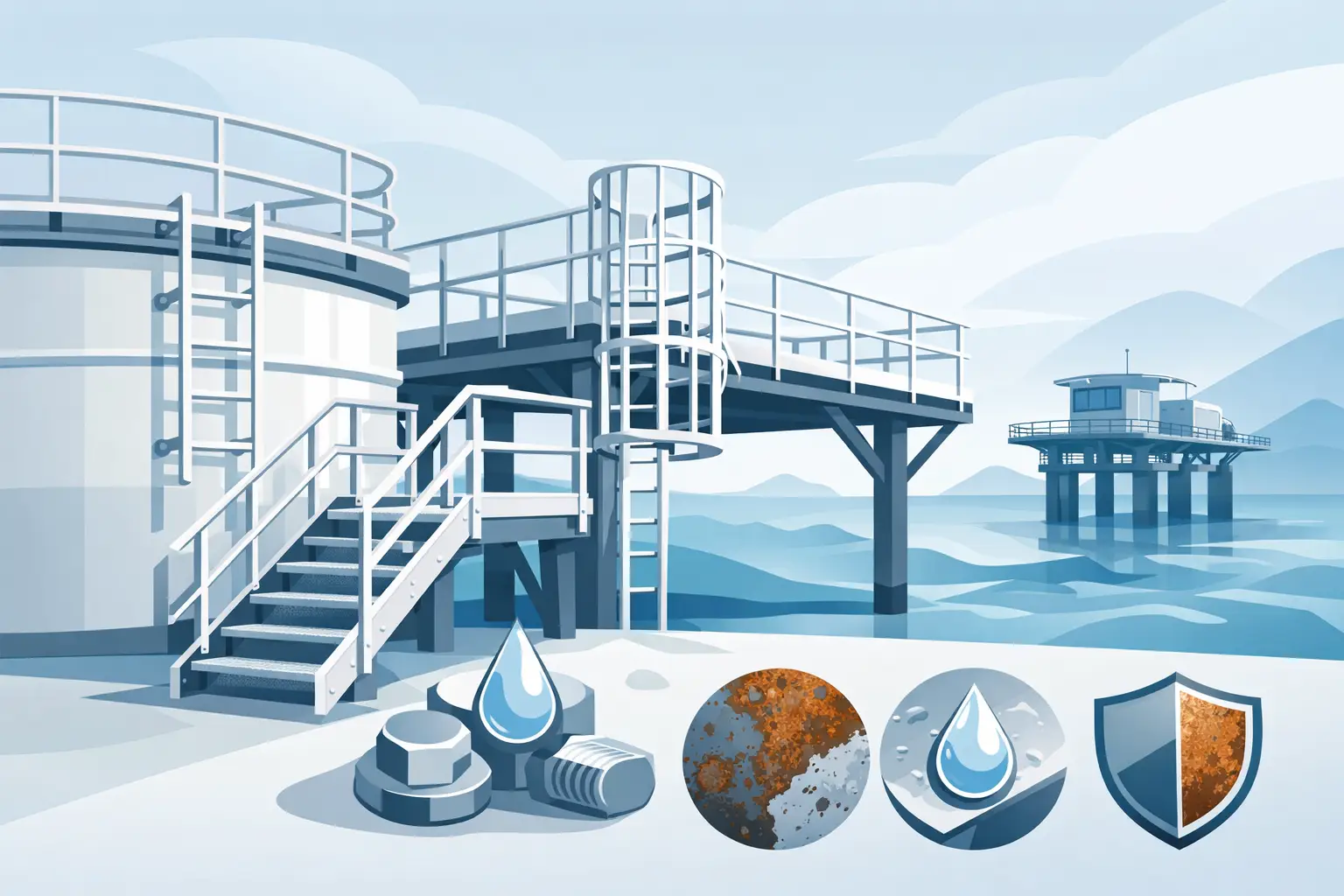
Corrosion Resistant Access Systems Guide
Corrosion resistant access systems guide for safer stairs, walkways and ladders in harsh sites. Compare materials, risk factors and lifecycle value.
A stair tower above a chemical bund, a ladder on a desalination skid, a walkway running across a marine deck - these are not secondary assets. They are critical access routes, and when corrosion starts to compromise them, the safety risk develops long before visible failure. This corrosion resistant access systems guide is written for operators and specifiers who need access infrastructure that remains safe, stable and compliant in harsh service conditions.
In most industrial environments, corrosion is not a standalone materials problem. It interacts with slip risk, load performance, inspection burden and shutdown planning. A system may still be standing, yet already be creating unsafe footing, uneven edges, weakened fixings or repeated maintenance interventions. That is why access system selection should be treated as a risk control decision, not simply a procurement exercise.
What a corrosion resistant access systems guide should help you decide
The right question is not only which material resists corrosion best. It is which access system maintains safe performance over time in your actual environment. That includes exposure to salt spray, standing water, washdown chemicals, process vapours, UV, impact, foot traffic and conductive hazards.
For many sites, conventional steel has a familiar appeal because teams know how it behaves and how to repair it. But familiarity does not always align with lifecycle value. In offshore, maritime, water treatment and chemical processing settings, repeated coating repair, localised metal loss and shutdown-based maintenance can make steel access systems expensive to own and difficult to keep in a consistently safe condition.
This is where non-metallic systems, particularly GRP composites, often change the specification conversation. They are not a universal replacement for every access application, but they can offer clear advantages where corrosion, weight and electrical conductivity all matter at once.
Where corrosion most often affects access systems
Access routes fail gradually in service. The early signs are usually operational rather than dramatic. A stair nosing starts to degrade. A grating panel edge becomes uneven. A ladder fixing shows surface breakdown. Water and contaminants collect where coatings have failed, and anti-slip performance drops as the substrate deteriorates.
In energy and maritime environments, chloride exposure is often the dominant issue. Saltwater and airborne salt attack unprotected or damaged metallic surfaces, especially at joints, cut edges and fixings. In process plants, the challenge may be chemical compatibility rather than salt alone. Acids, alkalis and cleaning agents can shorten the service life of standard materials if the specification is too generic.
Food and pharma environments introduce a different set of pressures. Frequent washdown, hygiene requirements and liquid contamination create a need for systems that are corrosion resistant, easy to clean and reliable under constant wet-foot conditions. Public infrastructure and transport assets face slower but still serious degradation from weathering, de-icing agents and sustained footfall.
Corrosion resistant access systems guide to material selection
Material choice should start with exposure mapping, not catalogue preference. Stainless steel, galvanised steel, aluminium and GRP all have legitimate roles, but each comes with trade-offs.
Galvanised steel can be cost-effective at initial purchase, and in lower-aggression environments it may provide acceptable service life. The limitation is that once the protective layer is compromised, deterioration can accelerate in local areas. That creates an inspection and maintenance burden that is often underestimated at project stage.
Stainless steel performs well in many corrosive settings, but grade selection is critical. The wrong specification in a chloride-rich environment can still produce corrosion issues, particularly around welds and fasteners. Stainless also carries a weight and cost profile that may not suit retrofit work or elevated structures.
Aluminium offers weight advantages, but compatibility with the surrounding environment and loading requirements must be checked carefully. In some industrial settings, it is a good solution. In others, particularly where mechanical abuse or certain chemical exposures are expected, it may not be the best long-term choice.
GRP composites are often specified when the access system must be non-corrosive, lightweight, non-conductive and low maintenance. For stairways, ladders, walkways, platforms and cable access routes, GRP can remove many of the recurring maintenance issues associated with corroding metals. It also supports anti-slip integration in a way that is useful for high-risk access areas. The main consideration is proper engineering. GRP should not be treated as a like-for-like substitute without checking spans, deflection, support spacing, fire performance and fixing details.
Performance criteria that matter beyond corrosion resistance
Corrosion resistance alone is not enough. An access system still has to perform safely under daily use, maintenance activity and emergency egress conditions.
Slip resistance is usually the first operational priority. A walkway that resists corrosion but becomes hazardous when wet has not solved the real problem. Surfaces should be selected for expected contaminants such as oils, seawater, mud, washdown residue or process liquids. This is especially relevant on external stairs, rig access areas, escape routes and service gantries.
Load capacity is the next critical check. Design teams should review point loads, distributed loads, maintenance equipment traffic and occasional impact. Lightweight systems can reduce installation complexity, but they still need to meet structural requirements for the application.
Electrical and thermal properties also matter. In substations, process plants and offshore assets, non-conductive materials can provide an added layer of risk reduction. In exposed settings, materials that remain dimensionally stable and safe to traverse across temperature ranges are preferable.
Then there is maintainability. The strongest lifecycle case is usually made by systems that do not require frequent coating repair, welding, blasting or disruptive shutdown work. In operating facilities, reduced maintenance intervention is not only a cost issue. It is also a permit-to-work and exposure reduction issue.
Application-led specification for stairs, walkways and ladders
The most reliable specifications are built around the actual hazard area. Stairs need different attention from walkways, and ladders present a different risk profile again.
For stairs, the focus should be on anti-slip treads, visible nosings, dimensional consistency and resistance to edge degradation. In corrosive areas, replacement or overcladding solutions can be more practical than repeated patch repair, particularly where downtime must be controlled.
Walkways need stable footing, drainage and long-term surface integrity. In offshore wind, ports, treatment plants and rooftop plant areas, lightweight GRP walkway and grating systems can reduce dead load while maintaining corrosion resistance. That matters in retrofit schemes where the supporting structure has limited spare capacity.
Ladders are often overlooked until an inspection flags deterioration. Yet ladder side rails, rungs and connections are exposed to concentrated wear and serious consequence if failure occurs. Corrosion resistant ladder systems and rung covers should be selected with equal attention to slip performance, fixing security and user confidence during ascent and descent.
Common specification mistakes
The first mistake is treating all corrosive environments as equivalent. Salt spray on a vessel, caustic washdown in food production and chemical vapour in a treatment plant are not the same exposure condition.
The second is focusing on purchase price rather than intervention cost. A lower-cost access system that demands regular shutdown maintenance may be far more expensive over ten years than a higher-value non-metallic alternative.
The third is separating corrosion control from slip prevention. In practice, they are linked. Degraded surfaces, failed coatings and contaminated access routes often create both structural and pedestrian safety issues at the same time.
Another common issue is poor interface detailing. A well-specified grating panel or stair tread can still underperform if fixings, support frames or adjacent components are vulnerable to corrosion or movement. System thinking matters.
Building a stronger business case
For HSE, maintenance and procurement teams, the strongest case for corrosion resistant access systems is usually based on avoided risk and reduced lifecycle intervention. That means fewer repairs, less unplanned access restriction, lower inspection concern and more predictable compliance performance.
It also means faster installation in many retrofit scenarios. Lightweight composite systems can often be installed onto existing substrates without the heavy structural disruption associated with full steel replacement. That can shorten shutdown windows and reduce labour exposure in difficult areas.
Where buyers need practical evidence, application history matters. Suppliers with sector experience across oil and gas, maritime, infrastructure and processing environments are generally better placed to advise on what lasts in service and what tends to fail early. That application-led approach is one reason many teams specify Real Safety when corrosion, slip risk and long service life need to be addressed together.
The best access systems are rarely the most visible part of a site, but they are among the first assets to test whether a safety strategy is working under real operating conditions. Specify for the environment you actually have, not the one shown on a generic datasheet, and the asset will usually repay that discipline for years.
Similar Articles

Non Metallic Cable Trays for Industrial Environments
Non metallic cable trays for industrial environments. Discover the benefits of corrosion resistance, lower weight, electrical safety, and reduced maintenance.
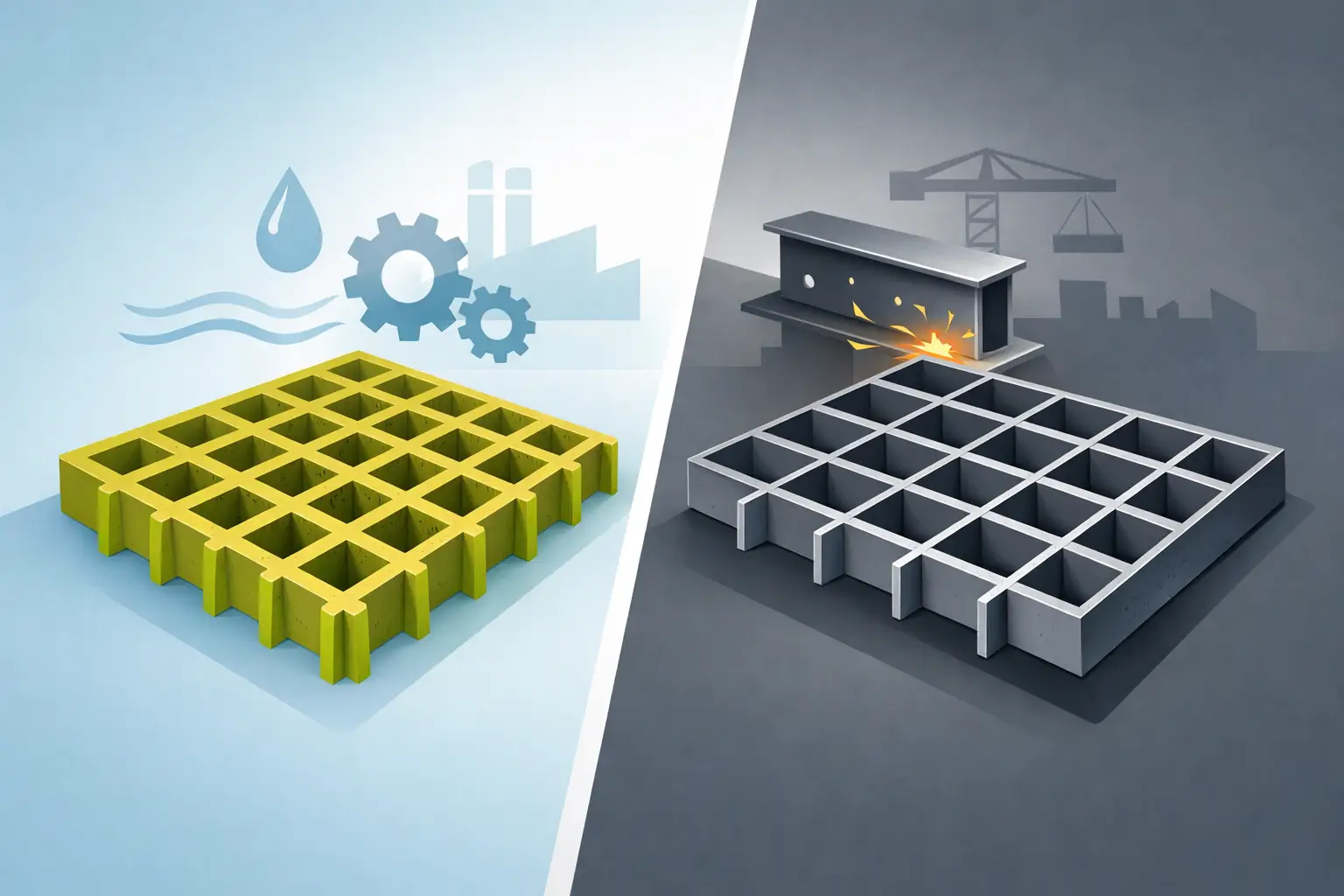
GRP Grating vs Steel Grating: Which Is Safer for Your Workplace?
Choosing between GRP and steel grating? Compare safety, durability, maintenance, and performance for industrial environments.
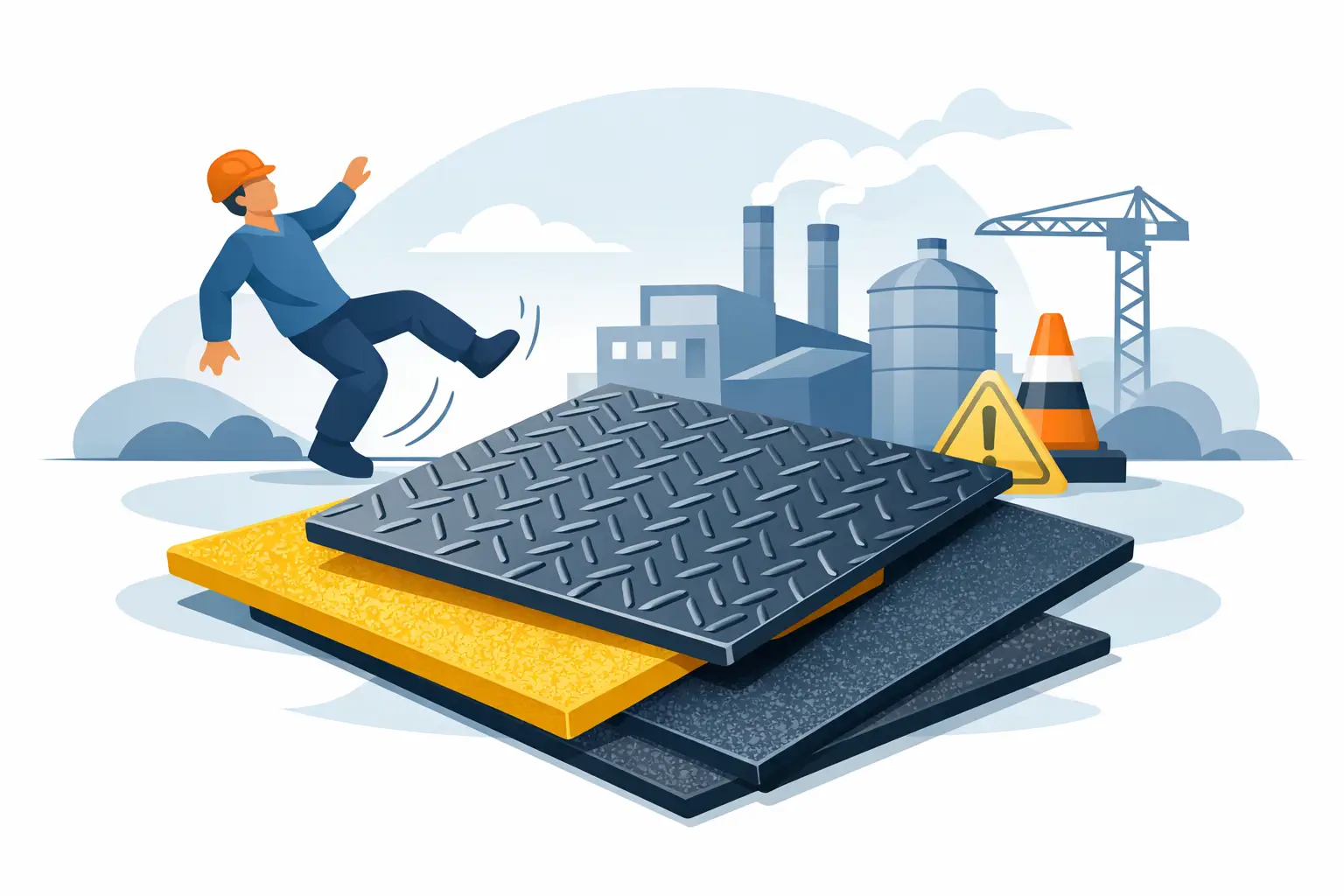
Anti Slip Floor Plates for Industry
Anti slip grp floor plates for industry reduce slips, corrosion issues and downtime across harsh sites with durable, compliant surface upgrades.