Dropped Object Netting That Actually Controls Risk
Dropped object prevention netting reduces falling-object risk on rigs, wind and industry. Learn where it fits, how to specify it, and avoid gaps.
A spanner slips off a platform handrail. Nobody sees it until it clips a lower grating panel, changes direction, and lands in a walkway that was meant to stay clear. The consequence is rarely just the dented tool it is the uncontrolled energy, the unpredictable bounce, and the fact that the drop zone is almost never as tidy as the method statement.
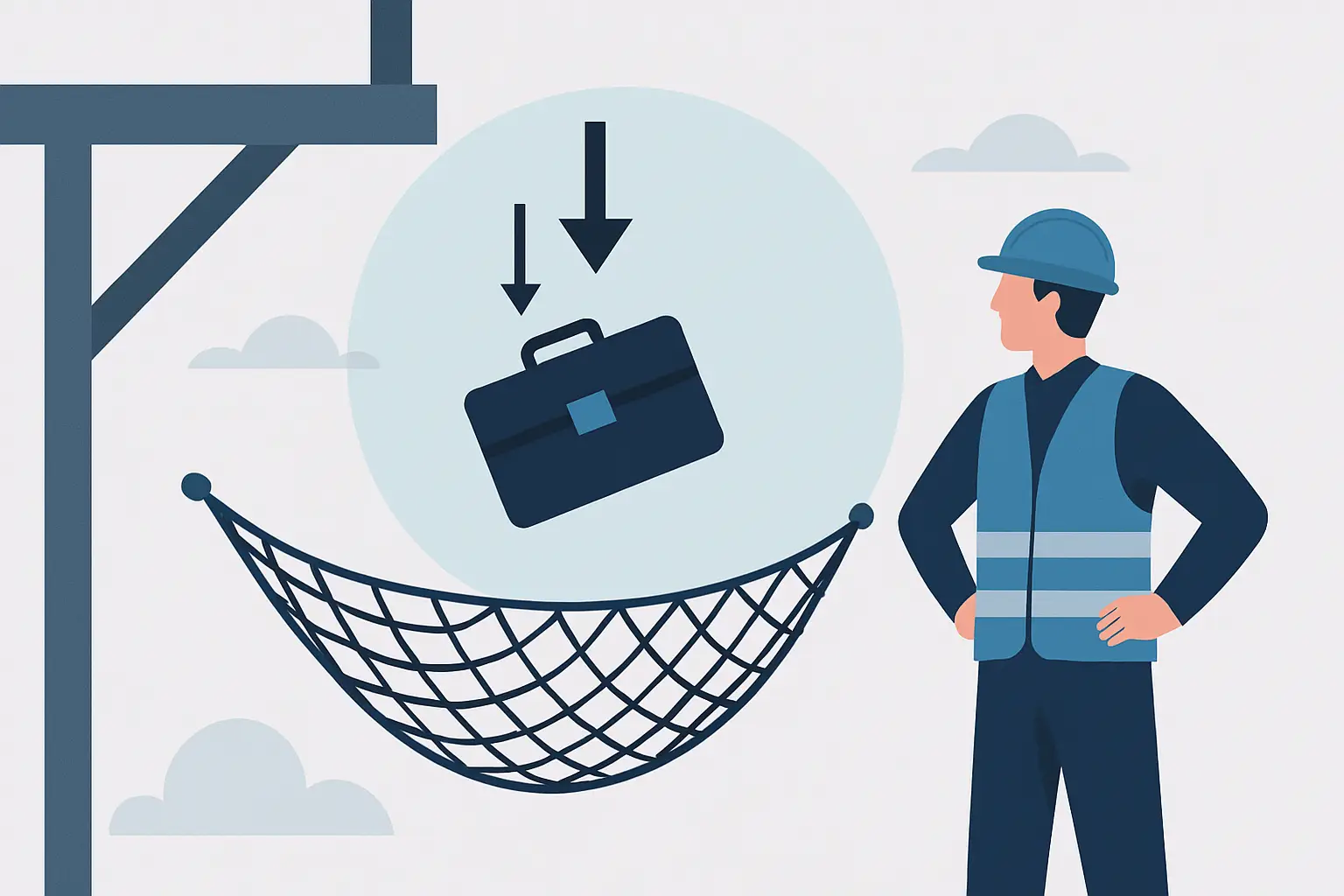
Dropped object prevention netting exists for this exact scenario: not as a general “safety add-on”, but as a physical control that stops dropped items travelling through open edges, gaps, or lower levels where people work.
Where dropped object prevention netting fits
Dropped object prevention netting is most valuable where work at height sits above occupied areas, access routes, or critical equipment, and where there is no practical way to eliminate the drop hazard through design alone. That includes rig floors and drill floor perimeters, derrick and substructure areas, maintenance platforms, scaffold interfaces, mezzanines, laydown edges, turbine transition pieces, nacelle work areas, and process plant structures with multiple levels.
In many assets, edge protection and toe-boards are already present, yet dropped objects still occur because the “object” is not always a tool. It might be a shackle pin, a tape measure, a nut, a cable cleat, a handheld radio, or a small component removed during corrective maintenance. Netting provides coverage where rigid barriers are discontinuous, where openings are required for access, or where the geometry is too complex to close out with metalwork.
It also supports housekeeping and access control. When an area is protected with netting, you reduce the reliance on temporary exclusion zones that can become operationally impractical in tight plants or on compact offshore structures.
Netting is not a substitute for tool control
Netting is a secondary control, not permission to relax primary prevention measures. Tool lanyards, tether points, tool pouches, fastener management, and disciplined materials handling remain essential. The operational reality is that tethering fails, lanyards are not always suitable for every task, and small parts still escape. The net is there for the residual risk.
This matters for compliance and assurance. When you present netting as part of a hierarchy of controls rather than a single fix you can justify it within your dropped object prevention programme and align it with inspection and maintenance routines.
Typical applications and the details that make or break them
Perimeter and handrail infill protection
Handrails often have mid-rails, but gaps still exist below, around stanchion bases, kick plates, gates, and at interfaces between modules. Netting installed as infill, properly tensioned and fixed, stops small items passing through or under rails.
The detail to check is termination and continuity. If the net stops 50 mm short of a post base because of an awkward bracket, that gap will be found by a falling nut sooner or later. The net must be detailed around penetrations and brackets, not simply cut and left.
Under-deck and platform underside capture
On multi-level structures, netting fixed beneath grating or around cut-outs can capture items that drop through open mesh or maintenance access points. This is particularly relevant where grating is modified on-site or where cable trays and services create additional drop pathways.
Here the trade-off is access. Under-deck netting can complicate inspection of the underside or access to services unless it is designed with removable sections and clear fixings. If it cannot be removed safely, it will be removed unsafely.
Lift zones and laydown edges
Lift routes, laydown areas, and temporary storage points generate dropped object risk because items are handled more frequently. Netting at edges and below transitions helps control the consequence of a slip, but only if the area is sized to the task. A small net protecting a large laydown edge tends to become “almost useful” and almost useful is not a control.
Specifying dropped object prevention netting: what buyers should demand
The goal is not simply to buy “a net”. You are specifying a system that needs to perform under predictable loads, survive the environment, and remain effective after years of UV exposure, salt, grit, chemicals, and routine washdown.
Define the hazard by credible dropped items
Start by identifying what is realistically being dropped in that location and from what height. A dropped podger spanner is different from a handful of bolts; a fall from a derrick board is different from a handrail top rail.
Your specification should state the maximum likely mass, the drop height range, and whether you are controlling:
- Through-drop (preventing passage to a lower level)
- Edge ejection (preventing items leaving a platform)
- Bounce and deflection (limiting travel into access routes)
Those three behaviours drive mesh size, net geometry, and how the net is tensioned.
Mesh size is about the smallest credible item
If the mesh aperture allows the smallest credible item to pass, the system fails in the way that matters most: silently. Many sites focus on “big” objects and forget fasteners, pins, clips, and consumables.
A practical approach is to work backwards from your task profile. If the zone includes flange work, instrument maintenance, or cable management, expect small components. If it is mostly lifting gear and large tooling, the aperture can be larger, but you still need to consider secondary drops such as split pins and shackles.
Fixings and edge detailing decide real-world performance
A net is only as good as the way it is attached. Specify how the net is secured to the structure, the spacing of fixings, and how corners, gates, ladder interfaces, and penetrations are treated.
Common failure modes are predictable: cable ties used where engineered fixings are required, fixings spaced too far apart leading to sag and gaps, and sharp edges causing abrasion and progressive fibre damage. In high-consequence areas, “temporary” attachment methods have a habit of becoming permanent.
Environment and lifecycle: UV, salt, chemicals, and heat
Offshore and coastal assets see UV exposure, salt spray, and wind-driven grit. Process environments may involve hydrocarbons, cleaning chemicals, or temperature extremes. Netting material selection should be tied to the site environment, including any washdown regime.
It is worth being explicit about expected service life and inspection intervals. A low-cost net that needs frequent replacement can create downtime and can quietly degrade between inspections, especially if it is out of normal sight lines.
Fire performance and site rules
Many sites have defined requirements for flame retardancy, smoke, and toxic emissions, particularly in enclosed modules or near escape routes. Ensure the netting system matches site standards and does not compromise egress or signage.
Compatibility with access and operations
Dropped object prevention netting can introduce operational friction if it blocks access to valves, makes cleaning difficult, or interferes with door swings and gates. If that happens, the net will be cut, unclipped, or bypassed.
Build in maintainability from the outset: removable panels where access is required, clear labelling, and fixings that can be released and reinstated without improvised tools.
Installation and inspection: treat it as a safety system
Netting should be installed with the same discipline as other engineered controls. That means drawings or layout sketches, defined fixing points, and a clear acceptance check.
Initial checks should include tension and sag, full perimeter continuity, condition of contact points (no sharp edges, no pinch points), and verification that the net does not create new hazards such as snagging or trip points.
Inspection frequency depends on exposure and criticality, but the triggers are consistent: UV degradation, abrasion at edges, loose fixings, impact damage, and unauthorised modifications. If the net has caught a dropped item, treat that as an event. It may still be serviceable, or it may have been overloaded locally - either way it warrants a recorded inspection.
Netting versus rigid barriers: it depends on the interface
Rigid barriers, toe-boards, and solid infill panels offer strong physical separation and can be easier to inspect. They can also be heavier, more intrusive, and slower to retrofit, particularly on weight-sensitive assets such as wind structures or on legacy offshore platforms where hot work and fabrication time are tightly controlled.
Netting is lightweight, adaptable around complex geometry, and can be installed with minimal disruption when properly planned. The trade-off is that it relies heavily on correct detailing and ongoing inspection. If the environment is highly abrasive, or if repeated impacts are expected, rigid containment may be the better control.
In practice, most mature dropped object strategies use both. Netting closes the gaps and interfaces that rigid systems leave behind.
Integrating netting into a wider drop prevention approach
The strongest programmes treat dropped objects as a system problem: design, housekeeping, tool control, containment, and behavioural discipline. Netting supports that system when it is targeted at known pathways platform edges, open mesh, gate gaps, and multi-level interactions and when it is specified with realistic dropped-item assumptions.
For teams already standardising anti-slip surfaces, GRP access components, and engineered barriers, netting should be reviewed in the same way: as part of access safety and not as a standalone purchase. Suppliers that work across stairs, walkways, ladders, and drop prevention can often resolve interface issues early, which is where most netting failures begin. Real Safety, for example, positions drop prevention alongside composite access upgrades so the containment detail follows the way people actually move and work on the structure.
A useful closing test is simple: if an item falls from the most likely drop point during the most common task, can you explain with confidence exactly where it will go? If you cannot, netting is not a “nice to have”. It is a practical way to turn an unpredictable event into a controlled outcome.
Similar Articles

Non Metallic Cable Trays for Industrial Environments
Non metallic cable trays for industrial environments. Discover the benefits of corrosion resistance, lower weight, electrical safety, and reduced maintenance.

GRP Grating vs Steel Grating: Which Is Safer for Your Workplace?
Choosing between GRP and steel grating? Compare safety, durability, maintenance, and performance for industrial environments.
Anti Slip Floor Plates for Industry
Anti slip grp floor plates for industry reduce slips, corrosion issues and downtime across harsh sites with durable, compliant surface upgrades.