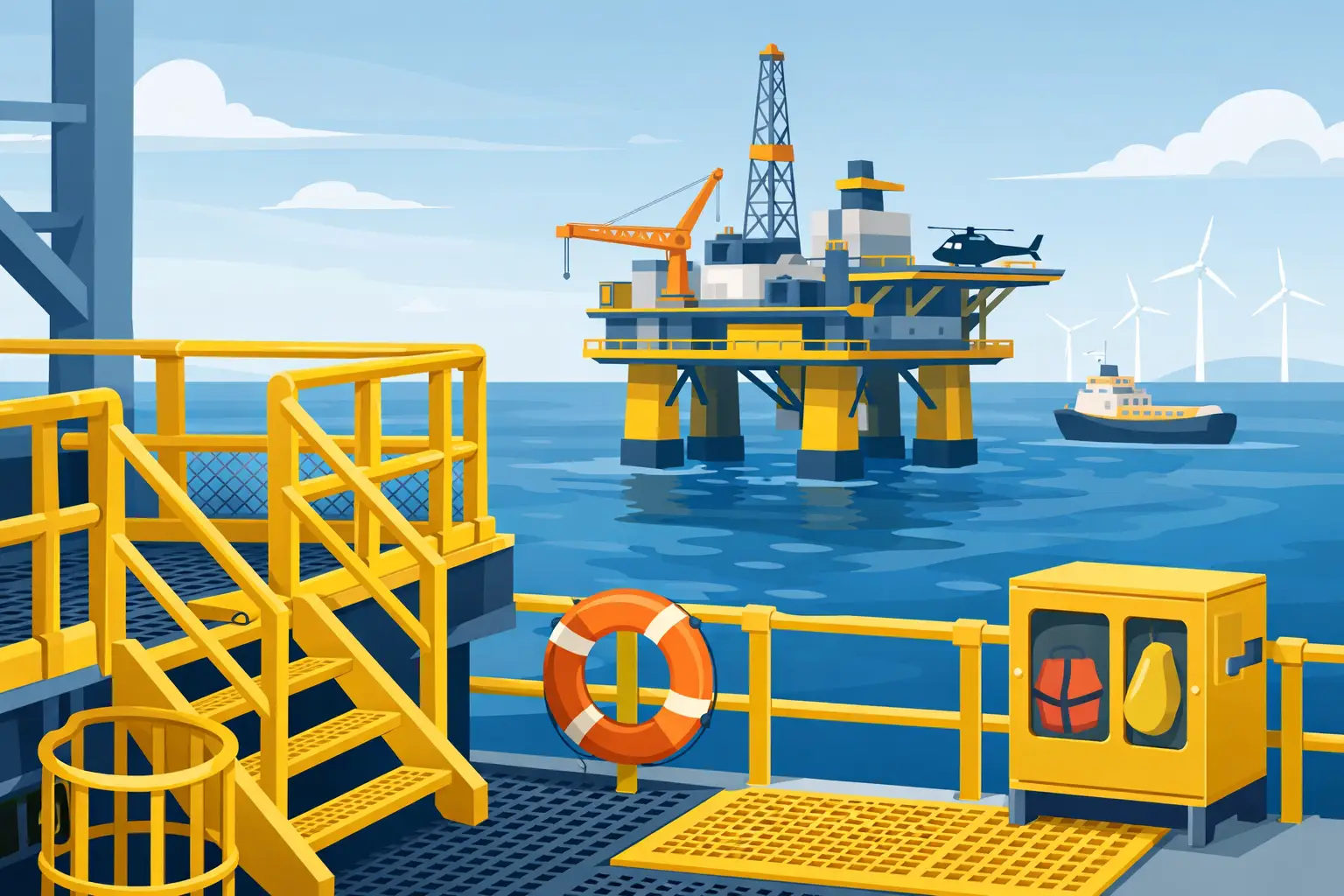
GRP Safety Products for Offshore Platforms
GRP safety products for offshore platforms reduce slip, trip and corrosion risks while cutting maintenance, weight and downtime in harsh marine use.
On an offshore platform, a walkway does not fail all at once. It loses grip under spray, edges corrode around fixings, and maintenance intervals shorten until a routine access route becomes a persistent exposure. That is why GRP safety products for offshore platforms are not simply a material substitution. They are a risk control decision tied to slip prevention, corrosion resistance, weight management, and long-term operability.
For HSE managers, maintenance teams and engineering buyers, the question is rarely whether these hazards exist. The real question is where GRP delivers the best operational value, and where a platform needs a more specific combination of anti-slip surfacing, structural composite components and drop prevention measures.
Why GRP safety products for offshore platforms are used
Offshore assets combine the conditions that degrade conventional materials fastest. Saltwater, chemical exposure, standing water, drilling residues, temperature shifts and heavy foot traffic all work against painted steel and untreated walking surfaces. Even where steel remains structurally appropriate, the safety interface - the point where people step, climb, cross or evacuate - often needs a different answer.
GRP composites are well suited to these environments because they are non-corrosive, lightweight and non-conductive. In practice, that means fewer maintenance interventions for access systems, less added load on existing structures, and a more stable anti-slip surface in wet or contaminated areas. It also means safety upgrades can often be fitted over existing substrates rather than requiring major steelwork replacement.
That said, product selection should stay application-led. A stair tread cover solving a worn nosing hazard is a different specification decision from a full GRP stairway, a ladder rung cover, or a helideck safety net. Treating all GRP products as interchangeable usually leads to overdesign in one area and underperformance in another.
Where offshore platforms benefit most
The highest-value applications are usually the ones with repeat exposure, frequent access and clear incident potential. Stairs are an obvious example. Steel stairs offshore often remain structurally sound long after the anti-slip profile has worn down or become unreliable under contamination. In those cases, GRP step covers, stair treads and nosings can restore traction quickly without the disruption of replacing the entire staircase.
Walkways and deck access routes are another priority. These are the areas where routine movement, weather exposure and operational residues combine. GRP walkway covers, deck strips and landing covers provide a defined anti-slip layer and can help standardise safe pedestrian routes across variable surfaces.
Ladder systems deserve separate attention. Ladder incidents are often influenced by wet rungs, awkward transfers and deteriorated contact surfaces rather than a single dramatic failure. GRP ladder rung covers and non-metallic ladder systems can improve footing consistency, particularly where corrosion and conductive materials are concerns.
Escape routes and emergency egress routes also benefit from GRP-based systems. Here, visibility and dependable footing matter more than aesthetics or lowest initial cost. Marked escape routes, anti-slip surfacing and corrosion-resistant access components support compliance and improve usability under poor weather and low-visibility conditions.
Anti-slip performance matters more than material claims alone
A common procurement mistake is to focus on GRP as a material category and not enough on surface performance. Offshore buyers do not need a product that is merely corrosion-resistant. They need one that remains effective when exposed to water, oils, mud, drilling fluids or marine growth.
That is where engineered anti-slip systems matter. The resin system, grit profile, panel thickness, fixing method and substrate condition all affect performance. A good anti-slip cover fitted badly can create edge lift, water traps or premature wear. Equally, the right product with the wrong fixing detail can shift maintenance from the walking surface to the surrounding steel.
For this reason, application-specific products tend to perform better than generic panels cut on site for convenience. Stair step covers should match nosing geometry and traffic load. Walkway covers should account for route width, drainage and edge transitions. Ladder rung covers should fit securely without compromising rung use or inspection.
Structural GRP and safety GRP solve different problems
Not every offshore hazard is addressed by anti-slip surfacing alone. Some environments need full non-metallic construction elements because corrosion, weight or maintenance burden make steel a poor long-term option.
GRP structural gratings, stairways, ladder systems, cable trays and pultruded profiles are often used where operators want a durable, lightweight alternative that reduces repainting, replacement cycles and access restrictions caused by maintenance work. In weight-sensitive offshore and nearshore applications, this can be especially useful.
But there is a trade-off. Structural GRP should be selected on engineering criteria, not simply because it is non-metallic. Load requirements, span, fire performance, deflection limits, chemical exposure and installation constraints all need to be assessed properly. In some platform areas, overlaying an existing steel surface with anti-slip GRP products is the most efficient option. In others, replacing secondary structures with GRP construction components offers stronger lifecycle value.
GRP safety products for offshore platforms and lifecycle cost
Initial purchase price is only one part of the offshore cost picture. Access restrictions, hot works permits, scaffold requirements, repainting cycles, corrosion repairs and repeat shutdowns often outweigh the material cost difference between steel-based repairs and composite safety upgrades.
This is where GRP products tend to justify themselves. Lightweight components are easier to handle and install. Non-corrosive materials reduce recurring maintenance. Anti-slip covers can often be retrofitted onto existing surfaces, limiting downtime and avoiding unnecessary structural replacement.
For maintenance managers, this matters because a safety product that lasts and needs little attention is not just a procurement win. It reduces future intervention hours in difficult environments. For HSE teams, consistent surface performance lowers the chance that an old access route slips back into the hazard register six months after a fix was signed off.
A warranty can support confidence, but it should not replace technical review. The better question is whether the supplier can demonstrate product fit, installation method and evidence from comparable offshore or energy-sector applications.
Specifying the right system offshore
The strongest specifications usually begin with the hazard map, not the catalogue. Start with where slips, trips, ladder access issues, corrosion-related degradation and dropped object risks are concentrated. Then match each area to the product type designed for that exposure.
A rig floor or setback area may require heavy-duty anti-slip treatment and clear demarcation. Stair towers may call for step covers, nosings and landing covers to create a consistent walking interface. Pipe rack access routes may benefit from GRP gratings or walkway covers. Helideck and upper-level areas may need drop prevention measures as well as underfoot safety controls.
Compliance teams should also consider inspection practicality. If a product makes routine checks harder, hides corrosion without addressing it, or introduces awkward fixing details, it may create a different maintenance issue later. The best offshore systems improve safety while remaining straightforward to inspect and maintain.
For many operators, an integrated approach is more effective than isolated upgrades. Combining anti-slip stair and walkway products with GRP access components and drop safety controls addresses the full route of movement rather than one visible hazard at a time.
What a credible supplier should be able to show
Offshore buyers are right to ask for evidence. Datasheets, load information, fixing details, resin and grit specifications, and installation guidance should be standard. So should sector experience. A supplier that understands oil and petrol, marine and wind applications will generally ask better questions about contamination, maintenance access, shutdown windows and compliance expectations.
Real Safety approaches these projects as engineered safety upgrades rather than commodity supply, which is usually the right fit for offshore work. That matters when the requirement is not just to purchase GRP products, but to reduce incident exposure across stairs, walkways, ladders, escape routes and high-risk deck areas with minimal operational disruption.
The strongest offshore outcomes usually come from practical scope definition: which areas need overlay products, which need full GRP construction components, and where drop prevention should sit alongside underfoot safety. When that is done properly, GRP becomes more than a corrosion-resistant alternative. It becomes part of a longer-life safety system designed for real operating conditions.
Offshore platforms do not reward generic fixes. If a product is going to earn its place, it needs to improve grip, hold up against exposure, and reduce the maintenance burden that quietly drives future risk. That is the standard worth specifying against.
Similar Articles

Non Metallic Cable Trays for Industrial Environments
Non metallic cable trays for industrial environments. Discover the benefits of corrosion resistance, lower weight, electrical safety, and reduced maintenance.

GRP Grating vs Steel Grating: Which Is Safer for Your Workplace?
Choosing between GRP and steel grating? Compare safety, durability, maintenance, and performance for industrial environments.
Anti Slip Floor Plates for Industry
Anti slip grp floor plates for industry reduce slips, corrosion issues and downtime across harsh sites with durable, compliant surface upgrades.