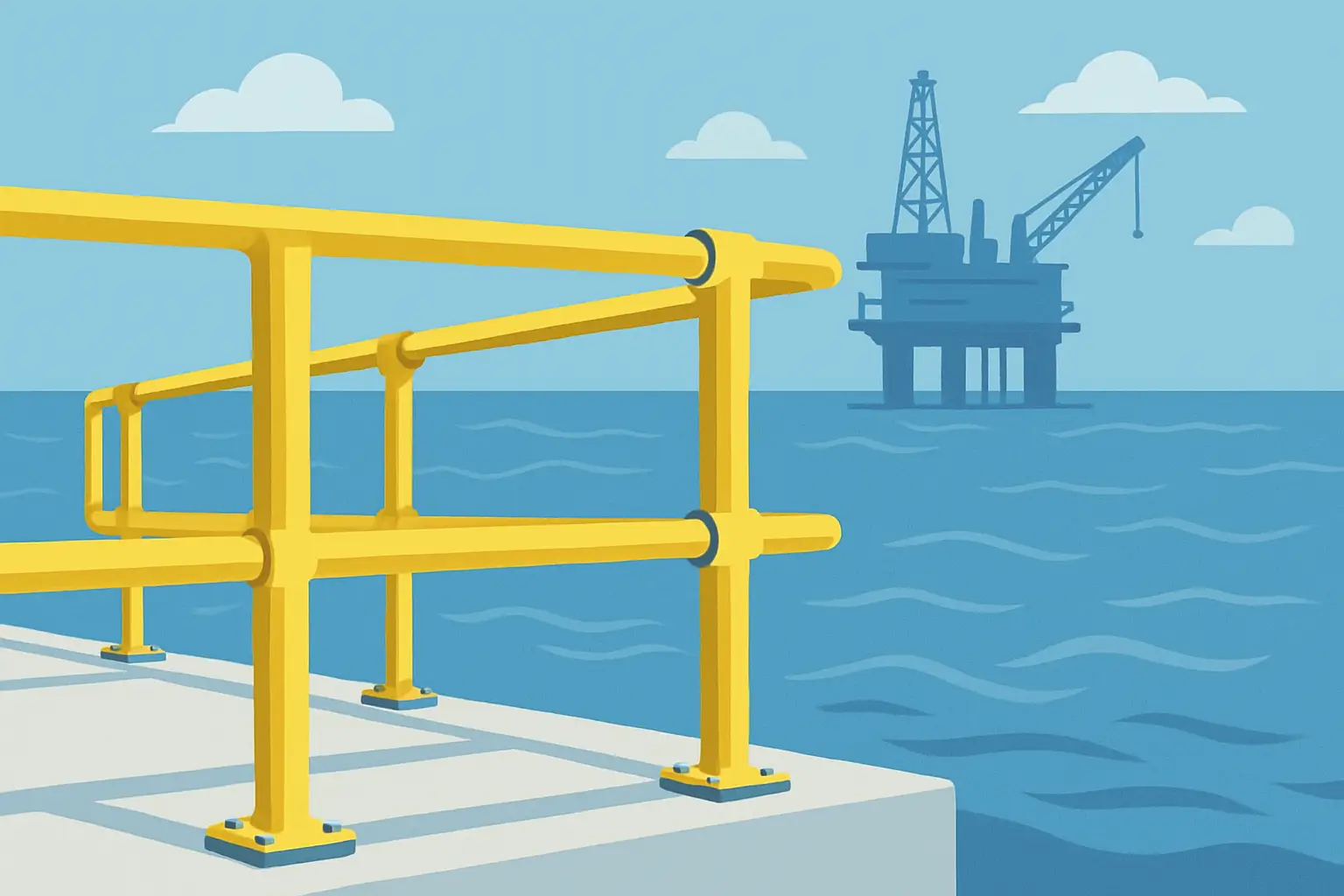
GRP Handrails Offshore: Safer, Lighter, No Rust
GRP composite handrails for offshore assets reduce corrosion, weight and maintenance while supporting compliance, safer access routes and uptime.
On an offshore asset, a handrail is rarely just a barrier. It is a primary risk control on every access route that matters: stair towers in spray zones, grated walkways above process equipment, ladder transitions, laydown areas, helideck approaches, and any location where wet contamination and wind-driven salt make loss of balance more likely. When handrails corrode, loosen at fixings, or demand frequent repainting and remedial work, the impact is not cosmetic - it directly affects stability, inspection outcomes, and how confidently people move through the plant.
That is why GRP composite handrails for offshore applications have become a practical engineering choice rather than a niche specification. The driver is simple: offshore environments punish metallic systems, and the operational cost of fighting corrosion - plus the downtime needed to do it safely - is often higher than the cost of choosing a non-metallic system in the first place.
Why offshore sites move away from metal handrails
Steel and aluminium can perform well in controlled conditions, but offshore exposures are not controlled. Salt-laden moisture, cyclic wetting and drying, UV, temperature swings, cleaning chemicals, and constant vibration all accelerate degradation. Even with coatings and careful isolation, you are typically managing a lifecycle where inspection flags, touch-up campaigns, and local replacement become routine.
GRP (glass-reinforced plastic) changes the failure mode. Instead of corrosion driving section loss and coating breakdown, a correctly specified GRP system is primarily managing mechanical loads, joint integrity, and long-term surface ageing. The material does not rust, and it does not require painting to provide corrosion protection. For maintenance planners, that shifts effort from repeated cosmetic and structural refurbishment towards periodic condition checks.
There is also a weight argument that matters offshore. Lighter handrail components reduce manual handling risk during installation and make logistics simpler when everything is moved by basket, crane, or helicopter. Weight reductions do not only benefit newbuilds - they can remove constraints during brownfield upgrades where lifting plans and access are the limiting factor.
What GRP composite handrails are, in practical terms
A GRP handrail system typically uses pultruded profiles. Pultrusion produces consistent sections with continuous glass reinforcement, giving predictable mechanical properties when compared with chopped strand laminates. The result is a modular set of posts, rails, mid-rails and kick plates (where required), assembled using mechanical fasteners and purpose-designed connectors.
For offshore use, performance is not just about strength. The system needs stable geometry under load, resistance to impact, and reliable connections that stay tight under vibration. It also needs to integrate with the rest of the walking surface - gratings, stair treads, step nosings, landing covers and edge protection - so the whole route behaves like one engineered control.
Offshore performance factors that actually decide success
Corrosion and coating elimination
With GRP, the core benefit is eliminating rust and the coating programmes that come with it. That does not mean “no inspection”, but it can mean fewer corrosion-related corrective work orders and fewer cases where a rail is structurally sound but fails visual inspection due to coating breakdown.
Electrical and thermal characteristics
Non-metallic handrails can reduce certain electrical risks where isolation is desired. They also tend to be more comfortable to touch in cold conditions than bare metal, which can support compliance in exposed areas where gloves are not always worn correctly during short transits.
UV and weathering
Offshore handrails are exposed, and GRP needs to be specified with UV performance in mind. Long-term colour shift or surface chalking can occur depending on resin system and finish. This is not usually a structural issue, but it affects appearance and can influence perceived condition during audits. If appearance and visibility are critical, specify for UV stability and ensure colour selection supports site standards.
Fire performance and smoke requirements
Fire performance is a specification area where “GRP” is not one uniform answer. Resin choice influences fire behaviour, smoke generation, and toxicity. Offshore projects commonly require defined fire performance characteristics, and the handrail system needs to match the platform’s safety case requirements and relevant standards. This is a genuine “it depends” area - you select the resin system and documentation to suit the asset and jurisdiction.
Impact and abnormal loads
Handrails get hit - by tool bags, hose reels, movable equipment, and occasionally by people falling with momentum. GRP systems can be engineered for these loads, but you must confirm loading requirements and post spacing rather than assuming a like-for-like swap from steel. Where there is a credible risk of vehicle or trolley impact, add physical protection or change the layout rather than relying on the handrail to be the sacrificial element.
Compliance and engineering: what buyers should verify
Offshore buyers typically evaluate handrails through a combination of regulatory expectations, classification society requirements (where applicable), and internal engineering standards. The key is to treat GRP as an engineered system with traceable data, not as a generic substitute.
At procurement stage, you should expect clear documentation for mechanical properties, allowable loads, connection details, and installation guidance. Ask how the system manages: post base fixings, edge distances, galvanic isolation where mixed materials exist, and tolerances on existing steelwork. If the installation is a retrofit on corroded structures, the substrate condition and fixing strategy matter as much as the handrail itself.
Also consider visibility and demarcation. Offshore routes rely on quick visual cues, particularly in poor weather and low light. Choosing standard safety colours can support safe behaviour, but it must align with site conventions so that colour is a signal, not noise.
Where GRP handrails deliver the most value offshore
GRP composite handrails for offshore are most compelling where corrosion and maintenance access collide. Splash zones and perimeter walkways are obvious candidates, but there are less visible areas where lifecycle gains are often higher.
Stair towers and ladder transitions see concentrated footfall, frequent hand contact, and regular washdown. The more often a route is used, the more disruptive it is when sections are tagged or restricted. Process areas with airborne contaminants and chemical exposure can also benefit, particularly where cleaning regimes are aggressive and metal coatings degrade quickly.
Handrails also matter around anti-slip upgrades. When you install stair treads, step covers, landing covers, or walkway covers to control slip risk, people naturally use the handrail more actively. A stable, corrosion-free rail complements the anti-slip surface - it reduces the likelihood that a slip becomes a fall, and it supports confidence on steep stairs or exposed runs.
Installation realities offshore: downtime, interfaces, and workmanship
A strong GRP specification can still fail if installation is treated as a simple bolt-on. Offshore upgrades are constrained by permits, weather windows, and limited laydown space. Modular GRP systems can help by reducing hot works and simplifying handling, but only if the interface details are planned.
Start with a survey that captures as-built dimensions and obstructions. Offshore steelwork is rarely as square as drawings suggest, especially after years of modifications. If you intend to reuse existing baseplates or holes, confirm they are sound and correctly located. If new drilling is needed, plan swarf control and ensure it fits the platform’s contamination controls.
Workmanship also matters for long-term integrity. Fastener selection, tightening practices, and connector fit all affect whether the system stays rigid under vibration. A rail that “gives” under load is not only uncomfortable - it changes behaviour, encouraging people to avoid using the rail at the very moment they most need it.
Trade-offs and when GRP may not be the right choice
GRP is not a universal answer. If an area has extreme fire performance requirements that mandate metallic systems, or if the rail is expected to take high-energy vehicle impacts, a different approach may be better. Similarly, if an asset has strict aesthetic requirements that demand a particular finish or long-term colour stability without change, you need to specify carefully and accept that appearance can evolve over time.
There is also a commercial reality: the lowest-cost GRP system is not automatically the most suitable. Resin selection, reinforcement, connector design, and quality control are what separate a compliant engineered system from a basic product. Offshore projects pay for certainty. If data is vague, drawings are missing, or testing evidence is thin, the risk is transferred to the asset owner.
Specifying a GRP handrail system as part of a safer route
The most effective offshore upgrades treat handrails as one element in a route-level control strategy. That means aligning handrails with the walking surface, edge protection, and visibility measures.
If the route includes GRP grating, stair tread covers, or anti-slip nosings, make sure the handrail layout supports natural movement and three points of contact. Check that kick plates and toe boards are included where there is a drop risk for tools or loose items, and consider how the handrail integrates with drop prevention measures such as barriers, nets, or barricades in high-consequence areas.
In procurement terms, it helps to buy from a supplier that can engineer the interface between these components rather than treating them as separate line items. Real Safety supplies GRP composite safety systems for offshore and other high-risk environments, including handrails, gratings and anti-slip upgrades, with project support and datasheet-led specification at https://Realsap.com.
What good looks like after installation
A well-specified GRP handrail system should feel boring in the best possible way. It should be straight, rigid, comfortable to grip, and consistent across the asset. It should not introduce sharp edges, snag points, or awkward transitions at gates and landings. And months after installation, it should still look and perform like a deliberate engineering decision rather than a patch.
If you are planning an offshore handrail replacement or upgrade, treat the handrail as a measure of route integrity: the question is not only whether it meets a dimensional standard, but whether it reduces exposure to slips, trips and falls across the places people actually move - in weather, under load, and at speed when the job is urgent. Choose the system that makes safe behaviour the easy behaviour, because offshore rarely gives you a second chance to get that right.
Similar Articles
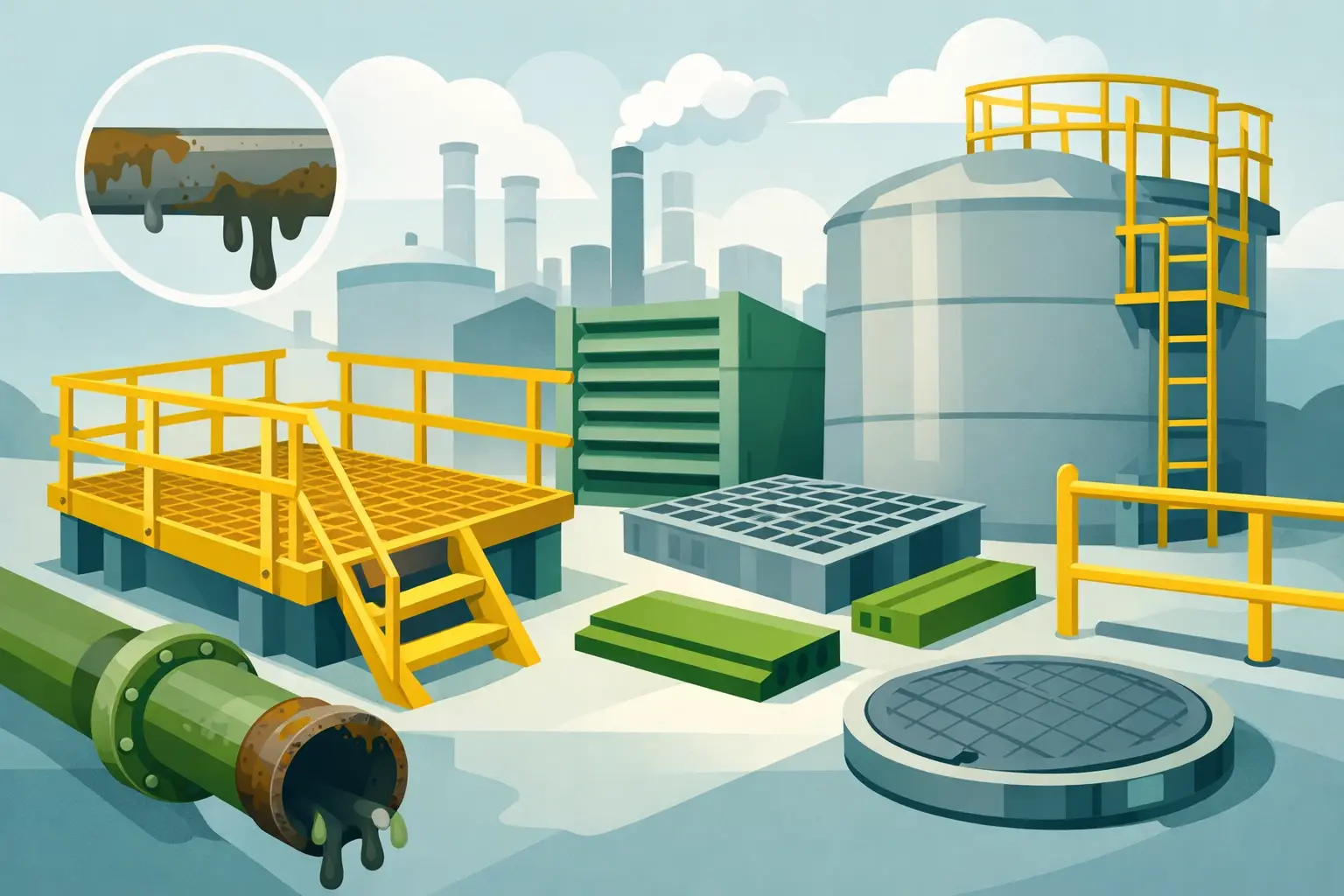
Top GRP Products for Corrosive Environments
Top GRP products for corrosive environments that improve safety, cut maintenance and support compliance across industrial and marine assets.
What are GRP composites used for in industry?
What are GRP composites used for in high-risk sites? See where GRP improves grip, corrosion resistance and compliance on stairs, walkways and ladders.
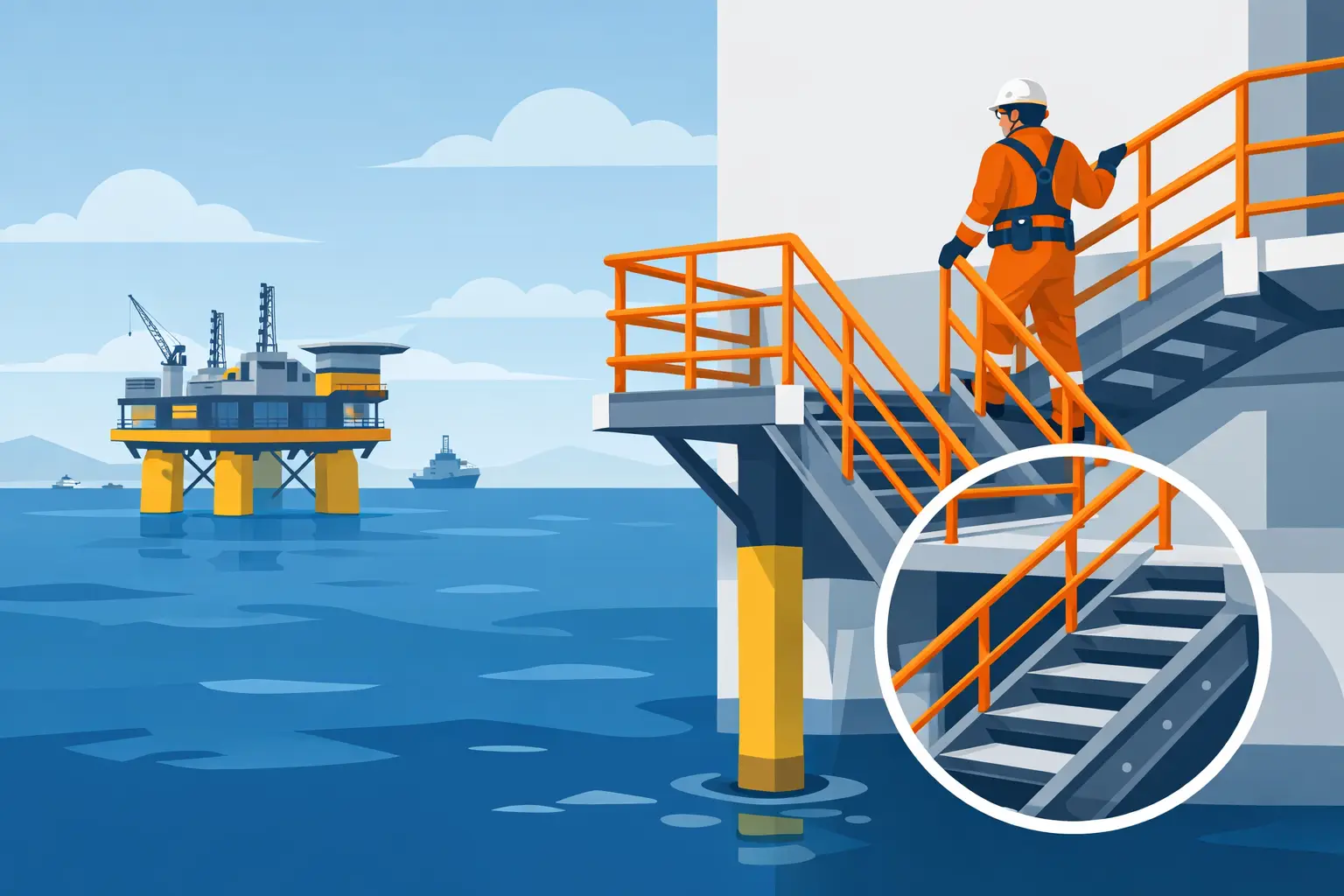
Offshore Stair Retrofit Case Study
Offshore stair retrofit reduced slip incidents case study showing how GRP stair covers improved grip, cut risk exposure and supported compliance.