
GRP Profiles That Make Fabrication Safer
A practical look at GRP profiles for industrial fabrication - where they fit, why they perform in harsh sites, and how to specify for safety and life.
If you have ever stripped a corroded angle off a coastal access platform or watched a handrail base plate fail long before its design life, you already know the weak link is rarely the main structure. It is often the interfaces - edges, terminations, transitions, and the small fabricated details that take impacts, hold fixings, and sit in the spray zone. That is exactly where GRP profiles earn their keep in industrial fabrication.
What GRP profiles do in industrial fabrication
GRP profiles are pultruded structural shapes made from glass reinforcement and a polymer resin system. In fabrication terms, they function like the standard steel catalogue - angles, channels, box sections, I-beams, flat bars, kick plates and custom shapes - but with a non-metallic performance envelope.
In high-risk environments, that matters for more than corrosion. Profiles are often used to form the boundaries of a walking surface, create ladder or handrail geometry, support grating, or protect edges. When these components degrade, the resulting hazards are predictable: sharp edges, loss of toe-board integrity, loose fixings, trip points, reduced containment, and unexpected downtime.
The reason GRP profiles for industrial fabrication are specified so frequently in Oil and Gas, renewables, water, ports and coastal infrastructure is simple - they reduce exposure to corrosion-driven maintenance while supporting safety controls such as anti-slip surfaces, edge protection and segregation.
Where GRP profiles typically sit on site
On most assets, profiles are not the headline product. They are the enabling structure that makes the safety system installable and maintainable.
Walkways, platforms and access ways
Profiles are commonly used as grating support frames, perimeter angles, bearers, and edge trims. In a corrosive zone, a steel perimeter angle can become the first component to delaminate coatings, trap water, and start the corrosion cycle that later compromises the walking surface. A GRP support detail avoids that failure mode and keeps the interface stable.
Stairs and landings
Stair treads and landing covers often require clean terminations and a consistent nosing detail. GRP angles and flat bars are used as trims, cover plates, and stiffeners where the geometry needs to stay true to maintain safe rise and going. On refurbishment projects, profiles also give a way to re-establish geometry without major hot works.
Ladders, handrails and guardrails
Non-metallic ladder side rails, rung supports, handrail posts, mid-rails and toe-boards can be fabricated from GRP profiles to reduce corrosion and minimise conductive risk. In chemical or marine environments, the value is usually lifecycle-driven - fewer inspections, fewer repaints, fewer component swaps - but the safety driver is consistent: reliable containment and stable access.
Cable management and secondary steelwork
Cable trays are the obvious GRP application, but profiles often support the tray system, act as standoff brackets, or form protective barriers around cable routes and trip hazards. Where segregation and housekeeping are part of your risk controls, keeping these supports straight and serviceable for years matters.
Why GRP behaves differently to steel in fabrication
A sensible specification starts with recognising that GRP is not a like-for-like replacement for steel. The performance advantages are real, but so are the design implications.
Corrosion resistance and predictable lifecycle
GRP does not rust. In practice, this means the section does not lose thickness in the same way a steel angle does when coatings break down. For assets where access is difficult and shutdown windows are short, that translates directly into reduced maintenance burden and less unplanned work at height.
The trade-off is that long-term performance depends on selecting the right resin system and UV protection for the environment. A generic profile can perform well indoors and disappoint on an exposed deck. The environment needs to be specified, not assumed.
Weight and handling
GRP profiles are lightweight compared with steel. That changes installation planning - fewer lifting constraints, easier manual handling, and in many cases faster retrofit work. In wind and offshore applications, weight also affects transport and load calculations.
The design check you cannot skip is stiffness. Deflection criteria can govern GRP designs more than ultimate strength, particularly on long spans or where the profile forms a support for a walking surface. If a component feels springy underfoot, it becomes a perceived risk even if it is structurally adequate.
Electrical and thermal behaviour
GRP is non-conductive and does not create a cold bridge like metal. For certain sites, that reduces risk exposure around electrical systems and improves comfort and condensation behaviour.
It is still essential to consider earthing and bonding strategies where they are required by site standards. Non-metallic does not mean non-compliant - it means the compliance approach is different.
Fire, smoke and toxicity performance
Fire performance in GRP depends on resin formulation, fillers and additives. If you are specifying profiles for escape routes, enclosed modules, or regulated facilities, the fire standard is part of the engineering requirement, not a brochure feature.
The practical point is to align profile selection with the area classification and the intended function. A profile used as a trim around anti-slip landing covers is not the same risk profile as a load-bearing component on an escape route.
Design and specification checks that prevent problems later
Most fabrication issues with GRP are avoidable. They tend to come from treating it like steel, or from leaving key details unspecified.
Define the environment precisely
Specify whether the installation is offshore splash zone, coastal atmosphere, chemical exposure, washdown regimes, or UV-exposed rooftop plant. Resin choice and surface veil selection should follow from that. If you cannot define exposure, you will end up over-specifying (cost) or under-specifying (premature degradation).
Confirm load paths and serviceability
Check both strength and deflection, and do it for the assembled system, not a single section in isolation. Profiles supporting grating or stair treads are part of a walking surface - vibration and deflection affect perceived safety and can drive complaints.
Decide how you will join components
GRP can be bolted, bonded, or a combination. Bolting is straightforward and inspection-friendly, but requires correct drilling practices, edge distances, and washer plates where needed to spread load. Bonding can produce clean designs and remove corrosion points, but it depends on surface preparation and controlled installation conditions.
For many industrial upgrades, bolted joints are the practical default because they suit live sites and allow controlled torqueing and later rework. If bonding is used, write the installation method into the scope so it is repeatable.
Plan for abrasion and impact
Profiles used as kick plates, edge protection or barrier rails see repeated impacts. GRP has excellent durability in many conditions, but local damage can occur if impact is concentrated. Where trolleys, dropped tools, or moving equipment are expected, consider sacrificial strips or thicker sections, and ensure the profile is not carrying a critical load if it is likely to be struck.
Specify tolerances and cut quality
Pultruded profiles are consistent, but fabrication tolerances still matter when integrating with steelwork, concrete interfaces, or existing structures. Define where tight tolerances are required, and avoid designing details that rely on field trimming in awkward positions.
Fabrication and installation considerations on live industrial sites
The practical advantage of GRP profiles is often realised during installation, especially on operational assets.
Cold works are commonly possible for cutting and drilling, which can reduce hot work permits and the operational burden around petrol testing and fire watch. That is not a blanket statement - site rules vary - but it is a common driver for selecting non-metallic components in refurbishment campaigns.
Dust control matters. Cutting GRP creates fine particulate, so method statements should include extraction, PPE, and clean-up controls to keep work areas safe and to prevent contamination of equipment. This is particularly relevant in nuclear and high-regulation facilities where foreign material exclusion is part of the operating culture.
Fixing selection also needs discipline. Stainless fixings are typical in corrosive environments, but the interface between stainless and GRP must be designed to avoid local crushing and to maintain clamp force. Use appropriate washers or plates, and torque to the manufacturer guidance rather than relying on steelwork habits.
How GRP profiles integrate with anti-slip and access safety
Profiles become significantly more valuable when they are treated as part of an integrated access system rather than a standalone structural shape.
A common example is edge detailing around anti-slip stair treads, nosings, and landing covers. A stable GRP trim or support angle protects edges, reduces snag points, and supports consistent surface contact so the anti-slip system performs as designed.
Similarly, where GRP gratings are installed, profiles allow you to fabricate frames, bearers and closures that maintain the integrity of the panel system. A corroded steel frame around an otherwise serviceable grating panel is a known failure pattern on maritime assets. Switching the perimeter detail to non-metallic removes that degradation mechanism.
For ladder safety upgrades, profiles support rung cover systems, ladder rung spacing corrections, and transitions onto platforms. The safety outcome is not that the ladder is made from a different material - it is that the access route stays stable, grippy, and compliant over time.
If you need an application-led range of GRP components that includes profiles as part of a wider anti-slip and access safety package, Real Safety at https://Realsap.com typically supports projects by matching the profile selection to the hazard and the interface detail, not just the section size.
When GRP profiles are not the right answer
There are scenarios where steel or other materials remain the better engineering choice.
High-temperature zones can exceed the limits of common resin systems. Severe point loads and very tight deflection limits can also favour steel, particularly where section depth is constrained. If the component needs to be welded into an existing steel structure as part of a coded welding scope, introducing non-metallic sections may complicate assurance.
There is also a competency aspect. If your fabrication contractor has not worked with GRP, the risk of poor hole quality, over-torqued fixings, or badly planned joints increases. That is not a reason to avoid GRP - it is a reason to specify method, inspection points, and acceptance criteria.
Selecting GRP profiles with a safety-first mindset
A procurement-driven specification that simply lists “GRP angle” is not enough for high-consequence environments. Treat the profile as a safety-critical interface component. Identify what hazard it controls - edge protection, containment, access stability, anti-slip system support - and then specify the environment, resin system, surface finish, joining method and inspection approach to suit.
The most reliable upgrades are rarely the ones with the biggest components. They are the ones where the small fabricated details do not become the next maintenance problem, and where the access route stays predictable underfoot in year one and year twenty-five. Your next fabrication job will go better if you start by walking the route, finding the interfaces that fail first, and designing the profiles around those real-world failure modes.
Similar Articles
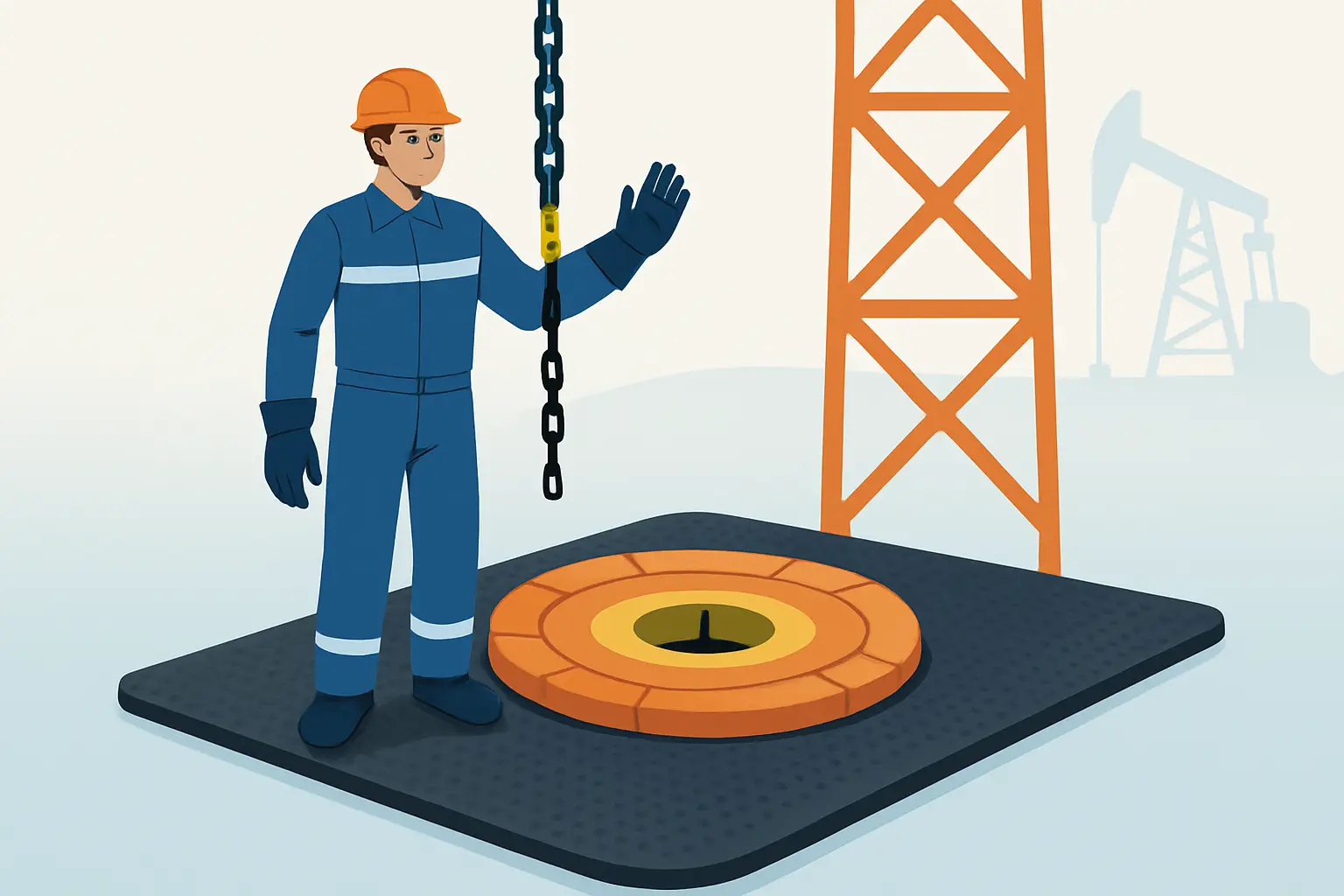
Rotary table anti slip mats for rig safety
Choose and specify a rotary table anti slip mat that cuts slip risk on rig floors - materials, fixings, drainage, compliance and lifecycle value.
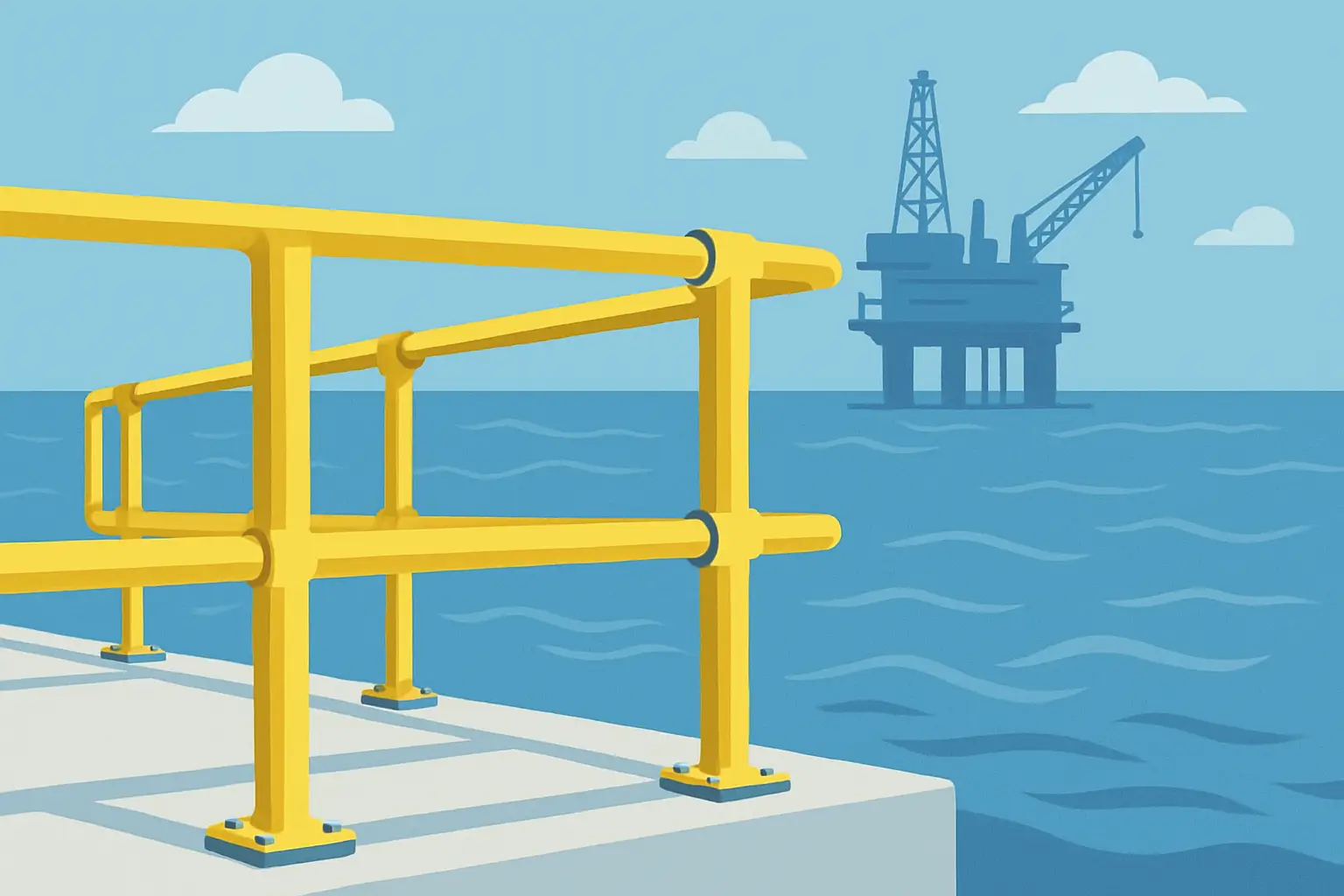
GRP Handrails Offshore: Safer, Lighter, No Rust
GRP composite handrails for offshore assets reduce corrosion, weight and maintenance while supporting compliance, safer access routes and uptime.
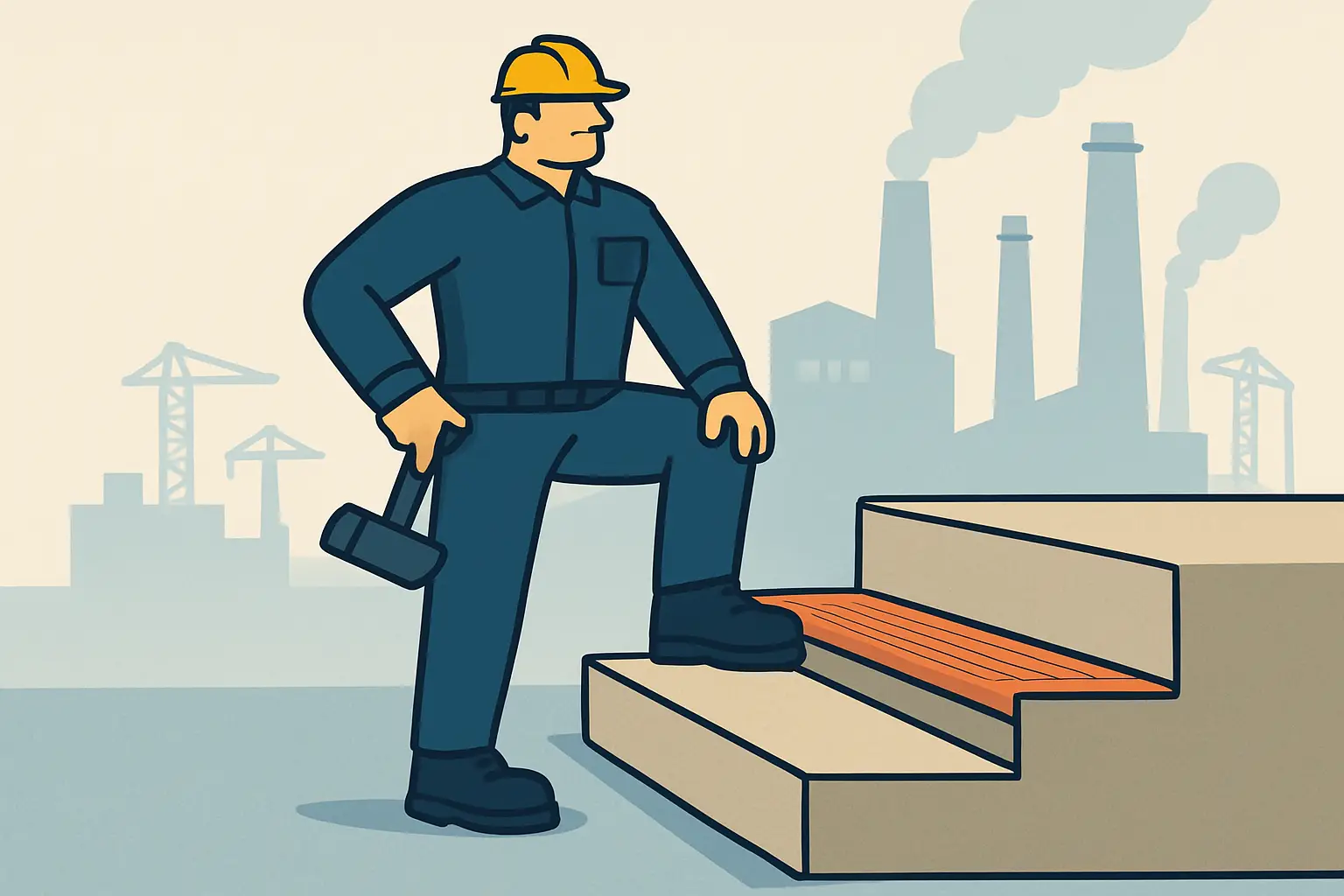
Stair Nosings That Stand Up to Industry
Choosing stair nosings for industrial steps: materials, fixings, slip resistance, corrosion, compliance and installation details for harsh sites.