GRP Stair Treads That Stand Up to Corrosion
GRP stair treads for corrosion protect access routes in harsh sites. Learn how composites outperform steel, what to specify, and where they fit best.
A corroded stairway rarely fails all at once. It softens at the edges, pits around fixings, stains under coatings, then starts to move under foot. By the time the first near-miss is reported, you often have two problems: degraded structural integrity and a surface that no longer provides reliable slip resistance. In coastal infrastructure, wastewater, chemical processing, and offshore assets, corrosion is not a cosmetic issue - it is a live risk on a primary access route.
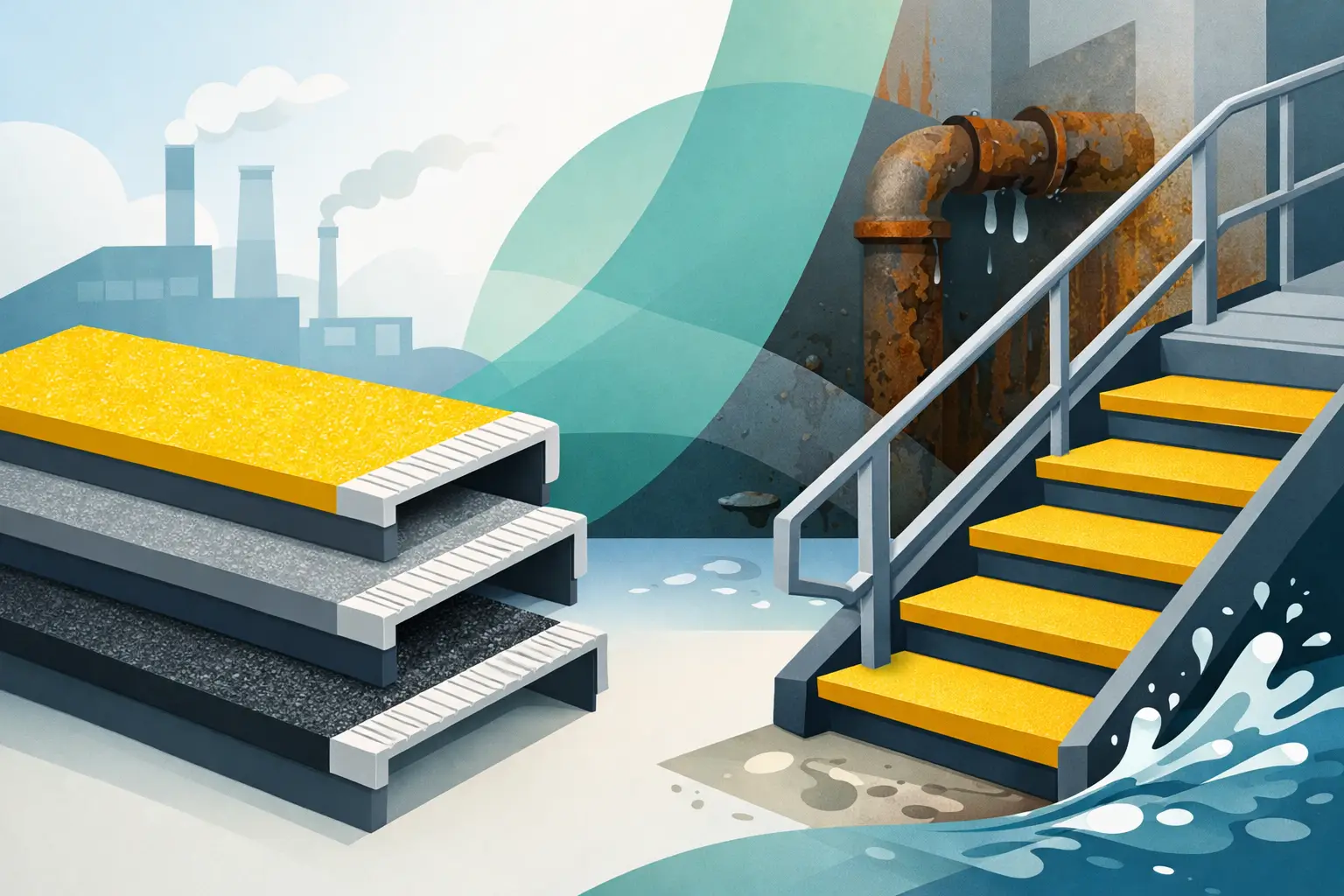
GRP stair treads for corrosion are specified to remove that failure mode from the outset. You are not trying to “protect steel for a bit longer”. You are switching the tread material to a non-metallic composite that does not rust, does not require repainting cycles, and maintains stable anti-slip performance in wet, contaminated, and salt-laden conditions.
Why corrosion changes the risk profile of stairs
Stairs are different from walkways because the user’s centre of mass moves vertically and the foot placement is less forgiving. A small change in tread geometry or friction can become a slip, trip, or fall event quickly, particularly when operatives are carrying tools, wearing PPE with contaminated soles, or moving between process areas.
Corrosion accelerates that risk in several ways. It reduces section thickness at the nosing and leading edge where loads concentrate. It undermines protective coatings, allowing contamination to sit under paint and create uneven surfaces. It attacks the interface around fixings, where movement and fretting can start. In marine environments it also contributes to persistent wetness and salt crystals on the surface, both of which reduce predictable grip.
When a stair set becomes an ongoing maintenance item, it creates a second operational hazard: repeated downtime, permits, and temporary access arrangements. For high-consequence sites, the maintenance burden itself becomes a safety and compliance concern.
What GRP actually gives you in corrosive environments
GRP (glass-reinforced plastic) composites are not “plastic stairs”. They are engineered laminates or moulded profiles where glass fibres provide strength and stiffness, and the resin system provides environmental resistance. For corrosive sites, the resin chemistry and surface finish matter as much as the nominal thickness.
The key performance advantage is straightforward: GRP is non-metallic and non-corrosive. That means there is no rusting of the base material and no hidden under-film corrosion. You remove the cycle of blast, prime, repaint, and re-inspect that steel stair treads typically require in salt air or chemical atmospheres.
The second advantage is stability of the walking surface. Industrial GRP tread systems are typically supplied with a bonded or integrated anti-slip surface (often grit-based) designed to maintain traction under water, oils, and process contamination. The tread remains consistent even when exposed to frequent washdown, provided the correct surface grade is selected.
There are trade-offs. GRP has different thermal behaviour to steel, and it is not the correct choice for every extreme temperature or fire performance requirement without confirming specification and compliance. It also relies on correct support and fixing design to avoid localised deflection. In other words, GRP reduces corrosion-related failures, but it does not remove the need for engineered selection.
GRP stair treads for corrosion - where they perform best
You see the strongest lifecycle benefit when corrosion is continuous or recurrent rather than occasional. Offshore and coastal stairs exposed to salt spray are a typical example - coatings are constantly challenged, and inspection intervals can become too frequent to be practical.
Water and wastewater facilities also make a strong case. Exposure to moisture, cleaning chemicals, and biological fouling can undermine metallic treads quickly. Similarly, chemical plants and process areas with acidic or alkaline vapours often experience accelerated attack at edges and fixings.
Renewables add a different constraint: weight sensitivity and a long service-life requirement. GRP components are lightweight, which can reduce handling risk during installation and can support upgrade programmes where access is limited. For wind and other renewables assets, buyers often evaluate on whole-life value over decades rather than short-term capex.
What to specify so corrosion resistance does not create a new problem
Selecting GRP because it “does not corrode” is only the starting point. On stairs, you are controlling multiple hazards at once: slip resistance, visibility, trip edge definition, and mechanical robustness under foot traffic.
Resin system and environmental compatibility
Corrosion resistance in GRP is primarily about resin selection and surface protection. In saltwater exposure this is usually straightforward, but chemical exposure requires confirmation against site-specific agents and concentrations. If you are dealing with acids, solvents, or aggressive cleaning regimes, treat this as a materials compatibility exercise, not a generic product choice.
Anti-slip surface grade and wear profile
A tread that survives chemically but polishes under traffic is not a win. Match surface aggressiveness to the contamination level and the footwear. For heavy industry, you generally want an industrial anti-slip surface that still performs when wet and contaminated, with enough durability to avoid frequent replacements.
Be realistic about wear. Any high-friction surface will change slowly with traffic, particularly on the nosing. Design your inspection regime to look at the leading edge and the centre line of travel, and treat replacement as planned maintenance rather than reactive work.
Nosing definition and visual contrast
Corrosive environments often have poor lighting, spray, and glare. A clear nosing line helps reduce mis-steps, particularly on external stairs. Contrast also supports compliance-focused upgrades where you need to demonstrate improved route safety rather than only material change.
Fixings, interfaces, and galvanic considerations
Even if the tread is GRP, the fixings may not be. In mixed-material installations, corrosion can simply relocate to the fasteners or supporting steelwork. Specify appropriate fasteners for the environment (including marine grades where required) and ensure the interface design avoids water traps.
It also matters whether you are overlaying existing steel treads or replacing them. Overlay systems can be effective for rapid upgrades, but only if the substrate is structurally sound. If the parent tread has lost section due to corrosion, a cover can hide a defect rather than control it.
Load, span, and deflection criteria
GRP systems can be engineered for industrial loading, but they should be specified against real use. Consider point loads (tool drops, trolley wheels if applicable), dynamic loading, and the way people actually use stairs in PPE. Deflection limits and support conditions should be checked, particularly on retrofits where stringer spacing and landing connections may not match standard assumptions.
Installation and maintenance - what “low maintenance” really means
A non-corrosive tread reduces maintenance, but it does not eliminate inspection. The practical difference is that you spend less time fighting material degradation and more time verifying performance.
During installation, the key controls are alignment, secure fixing, and clean interfaces. Poorly seated treads can create a trip edge. Over-tightened fixings can damage composite sections. If your work is in an operating plant, plan for contamination control as well - adhesives and bonding (where used) need correct surface preparation and cure conditions.
For ongoing maintenance, focus on surface cleanliness and periodic condition checks. Washdowns should remove oils, algae, and salts before they build. Inspections should look for localised impact damage, wear at the nosing, loosening fixings, and any movement at interfaces. In most corrosive environments, this is simpler and more predictable than managing coating breakdown on steel.
When steel (or another option) may still be the better choice
There are scenarios where GRP is not automatically the answer. Very high temperature exposure, hot work proximity, or specific fire performance requirements can drive you towards alternative materials or additional certification requirements. Heavy point-load applications may require careful selection of profile and support design, or a different solution entirely.
There is also the reality of site standardisation. Some plants have established specifications for metallic stairs and may require an engineering change process. In that case, the strongest route is often a targeted upgrade on the highest-risk access points first - external stairs, washdown areas, and corrosion hot spots - supported by documented performance.
A practical approach to specifying the upgrade
If you are building a case for GRP stair treads in corrosive environments, start with risk and lifecycle value. Look at the areas where corrosion is already causing repeat maintenance, slip risk, or downtime.
You will need to show service life and installation clarity for procurement, load and fixing data for engineering, and proven slip resistance for HSE.
Working with an application-led supplier such as Real Safety can help bring those requirements together with solutions designed for harsh environments.
Learn more about corrosion-resistant stair upgrades at Realsap.com.
Similar Articles

Non Metallic Cable Trays for Industrial Environments
Non metallic cable trays for industrial environments. Discover the benefits of corrosion resistance, lower weight, electrical safety, and reduced maintenance.

GRP Grating vs Steel Grating: Which Is Safer for Your Workplace?
Choosing between GRP and steel grating? Compare safety, durability, maintenance, and performance for industrial environments.
Anti Slip Floor Plates for Industry
Anti slip grp floor plates for industry reduce slips, corrosion issues and downtime across harsh sites with durable, compliant surface upgrades.