
Choosing an Anti Slip Safety Provider
Choose an anti slip safety solutions provider that delivers compliance, proven grip, low downtime and long service life in harsh environments.
What makes an anti slip safety solutions provider worth appointing?
A stair tread that looks acceptable on day one but loses performance after a wet winter, a chemical washdown cycle, or constant foot traffic is not a safety control. It is a short-term fix. For HSE, maintenance, and engineering teams, that distinction matters because slips, trips, and falls are rarely caused by one isolated defect. More often, they come from a surface that was never suited to the operating environment in the first place.
That is why selecting an anti slip safety solutions provider should be treated as an engineering decision, not a catalogue purchase. The right provider does more than supply products. It assesses where instability occurs, specifies the correct material and profile, and helps reduce risk without creating unnecessary shutdowns or structural replacement work.
In industrial settings, the challenge is rarely just "make it less slippery". Offshore stairs may be exposed to saltwater, hydrocarbons, and heavy boots. A food production walkway may see washdowns, oils, and strict hygiene requirements. A public venue may need a durable anti-slip finish that performs under high footfall without creating trip edges or maintenance burden. The solution depends on the hazard, the substrate, the traffic profile, and the compliance standard being worked to.
Why product performance alone is not enough
Many buyers begin with coefficient of friction figures or basic product dimensions. Those details matter, but they are only part of the decision. Anti-slip performance needs to remain consistent under actual service conditions, not only under test conditions.
A capable anti slip safety solutions provider will look beyond a single datasheet value and ask practical questions. Is the area dry, wet, oily, or chemically aggressive? Is the hazard on stairs, ladders, landings, or open walkways? Does the installation need to be carried out during a live maintenance window? Is there a need to retrofit over steel, concrete, timber, chequer plate, or existing grating?
Those details affect product choice immediately. GRP stair tread covers, for example, can be highly effective on worn or slippery steps because they create a durable anti-slip walking surface while avoiding a complete stair replacement. On the other hand, deck strips may be more suitable in localised risk zones, while full walkway covers can be justified where contamination is persistent across a wider route.
The best providers are application-led. They specify according to failure risk, not only according to product availability.
The value of GRP in anti-slip upgrades
For many industrial and infrastructure environments, GRP composites solve several problems at once. They provide an anti-slip surface, but they also bring corrosion resistance, low weight, electrical non-conductivity, and long service life. In sectors such as energy, maritime, process industry, and transport infrastructure, those characteristics often make the difference between a viable retrofit and an impractical one.
Steel can corrode, coatings can wear, and replacement works can be disruptive. GRP-based anti-slip systems are often installed onto existing substrates, which reduces downtime and avoids extensive structural intervention. That has clear operational value where shutdown windows are limited or where access is difficult.
There is a trade-off, of course. Not every area needs a full GRP solution, and not every budget allows for wholesale change across a site. Some hazards are better managed with targeted upgrades on stairs, ladders, escape routes, or known contamination zones. A credible provider will not overspecify. It should help you decide where a full covering system is justified and where a more localised treatment is enough.
How to assess an anti slip safety solutions provider
The first test is whether the provider understands your sector. Slip risk on an offshore asset is not the same as slip risk in a pharmaceutical clean area or a stadium concourse. The provider should be able to speak clearly about environmental exposure, loading, maintenance conditions, and access constraints relevant to your operation.
The second test is whether the product range covers the full hazard path. Slips and trips are not isolated neatly into one component. A safe route may involve external stairs, intermediate landings, elevated walkways, ladder access, and clearly marked escape paths. If a supplier can only address one of those areas, your team is left stitching solutions together and carrying interface risk across multiple vendors.
The third test is evidence. Industrial buyers should expect datasheets, material specifications, installation guidance, and case-based proof of use in comparable environments. Long service life claims are useful only when supported by field performance, warranty terms, and a clear explanation of what conditions the product is designed to withstand.
The fourth test is installation practicality. If the proposed upgrade requires major shutdowns, hot works, or complete substrate replacement, its safety value may be offset by project disruption and cost. Retrofit-compatible systems often provide a better route to compliance and incident reduction, particularly across ageing assets.
Where the right provider creates measurable value
An anti-slip upgrade is often initiated after an incident, audit finding, or deteriorating asset condition. But the real value goes beyond incident response. A well-specified system improves underfoot stability, standardises walking surfaces across high-risk routes, and reduces the maintenance cycle associated with temporary fixes and repeat coatings.
On stairs, this may mean fitting anti-slip step covers or nosings over worn substrates to restore grip and visibility. On walkways and landings, it may mean full covers that maintain performance despite water, oils, or process residues. On ladders, rung covers can help address a hazard that is frequently recognised but not always treated with the same urgency as floor-level slip risks.
Escape routes deserve particular attention. During an emergency, people are moving quickly, often in poor visibility or adverse weather. Anti-slip performance and route marking both matter. A provider that understands escape route risk will treat these routes as critical safety infrastructure rather than optional additions.
Compliance matters, but usability matters as well
Compliance is a buying driver for every serious project, but it should not be approached as a paper exercise. A compliant product that is difficult to install, awkward to maintain, or poorly suited to the substrate can create operational resistance and delay implementation.
That is why specification should always consider real use. In food and pharma, hygiene and cleanability may sit alongside anti-slip performance. In maritime settings, resistance to saltwater exposure and fuel contamination is central. In energy and process environments, chemical resistance and non-metallic construction may be essential. In public settings, durability under heavy footfall and consistent appearance may influence selection alongside risk reduction.
A strong provider balances those factors rather than forcing one generic product into every scenario.
Why a single-source approach can reduce project risk
When slip hazards extend across multiple asset areas, there is a practical advantage in working with a provider that can address stairs, treads, landings, walkways, gratings, ladders, and route markings as part of one engineered package. It simplifies specification, procurement, and installation planning.
It also improves consistency. Surface profile, visibility, fixing methods, and maintenance expectations can be aligned across the site. That may sound like a procurement detail, but consistency supports safer behaviour. Personnel are more likely to trust and use designated routes when the anti-slip treatment is visibly coherent and reliably underfoot.
For organisations managing broader risk controls, there is value in a provider that also understands adjacent safety disciplines. In some environments, slip prevention, GRP access infrastructure, and drop prevention are part of the same upgrade strategy. Keeping those conversations connected can reduce interface gaps during design and implementation.
What good looks like in practice
A capable partner will usually start with the application area, then narrow the solution. For a deteriorating external steel stair, the answer may be GRP stair tread covers with contrasting nosings and minimal interruption to operations. For a corroded process walkway, it may be a combination of anti-slip covers and composite grating. For a vessel or coastal asset, material resistance to salt exposure becomes a primary design factor, not a secondary one.
This is where sector experience matters. A provider that has worked for years in oil and gas, maritime, infrastructure, processing, and public environments is more likely to identify the practical constraints early. That includes fixings, shutdown timing, substrate condition, and the difference between a product that can be supplied and one that will genuinely hold up in service.
Real Safety operates in that way as an engineered safety supplier focused on GRP composites and anti-slip systems for demanding environments where long lifecycle value matters as much as immediate hazard reduction.
The best buying decisions in this area are rarely driven by lowest unit cost. They are driven by total risk reduction, installation practicality, and the confidence that the surface will still be doing its job years after handover. If a provider can demonstrate that clearly, you are not just buying anti-slip products. You are putting a more reliable safety control in place where it counts most.
Similar Articles
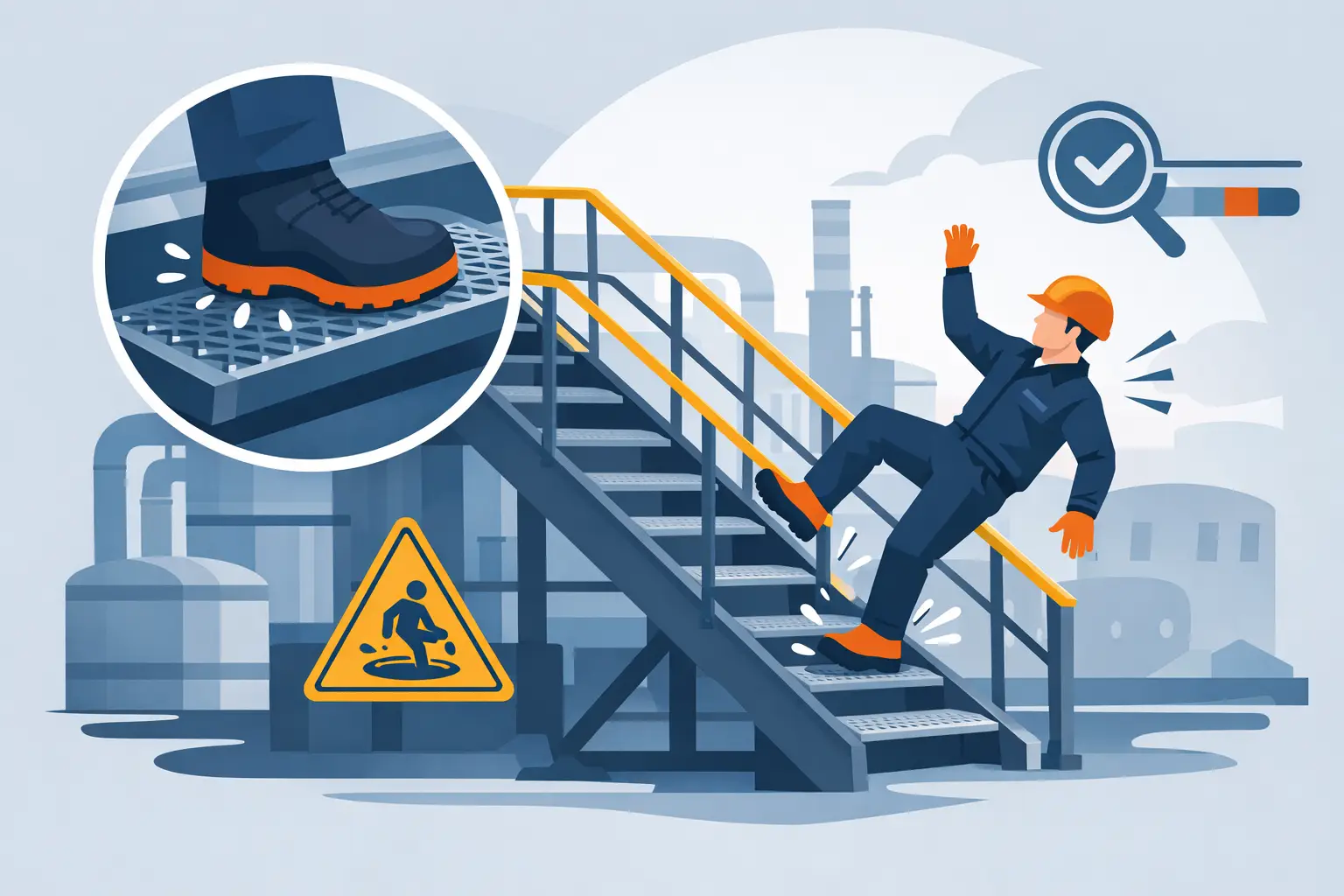
Slip Rating for Industrial Stairs
Find out what slip rating is needed for industrial stairs, how P ratings apply, and when stair nosings, treads or GRP covers are the safer choice.

Stop Dropped Objects on Platforms: What Works
Practical guidance on how to prevent dropped objects on platforms using engineering controls, housekeeping and drop prevention systems for safer work.
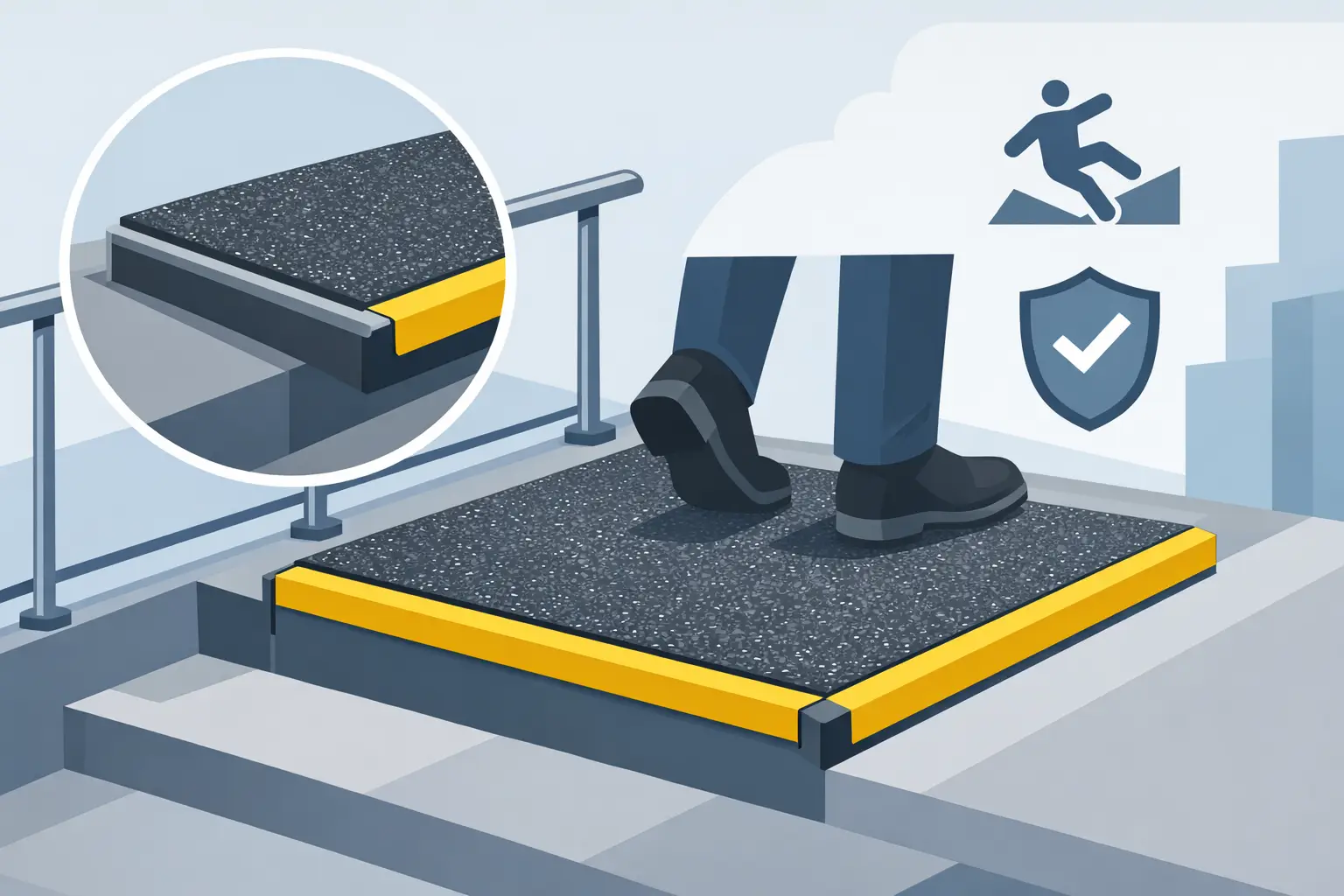
Anti-Slip Landing Cover Plates: What Works
Anti slip landing cover plates reduce slip risk on industrial stairs and platforms. Learn materials, fixings, tolerances and where each spec fits.